
South Division
Midpoint Recheck
Read the report here. Use the page controls to move through it.
of 15
Read this page as text
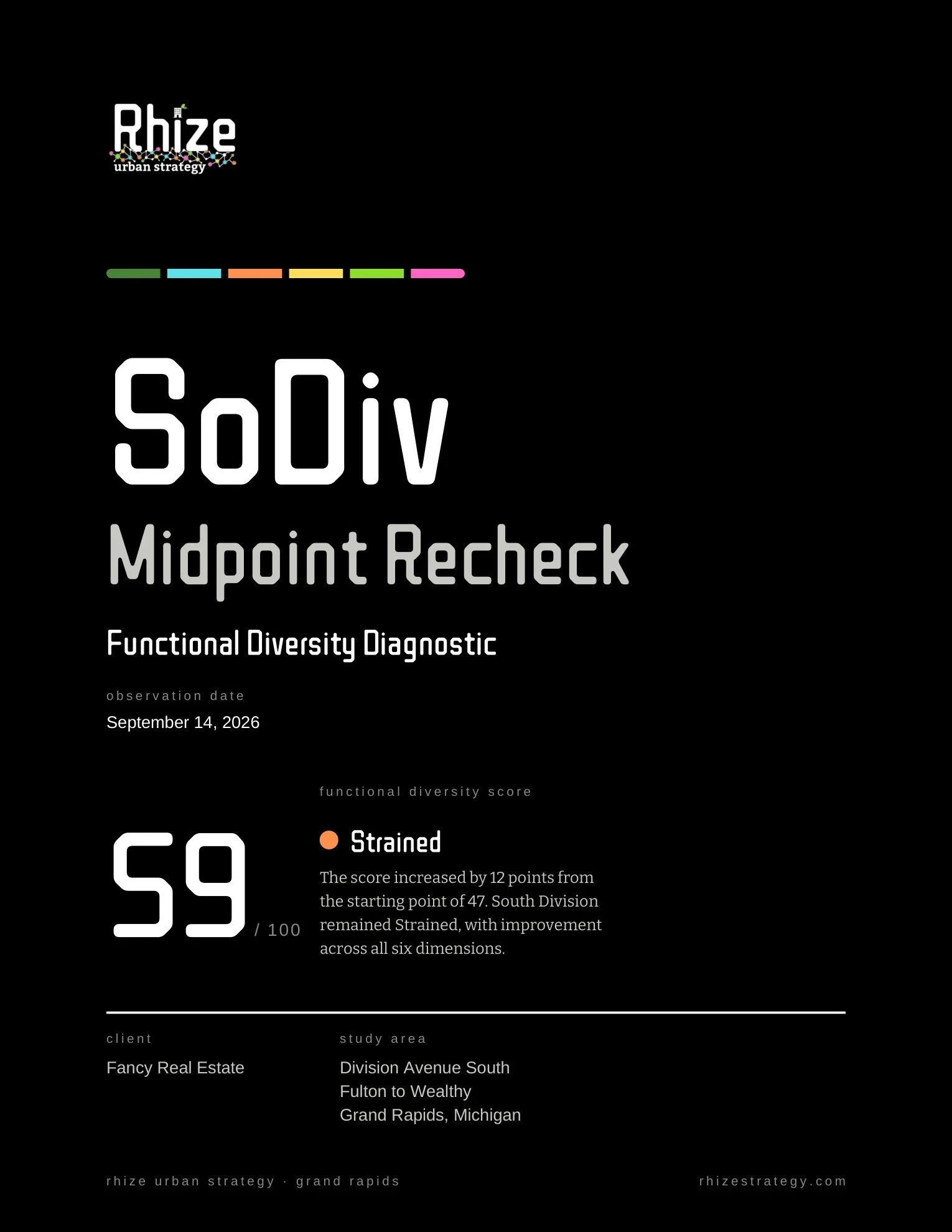
SoDiv
Midpoint Recheck
Functional Diversity Diagnostic
59
Strained
o b s e r v a t i o n d a t e
f u n c t i o n a l d i v e r s i t y s c o r e
c l i e n t
s t u d y a r e a
r h i z e u r b a n s t r a t e g y · g r a n d r a p i d s
r h i z e s t r a t e g y . c o m
September 14, 2026
Fancy Real Estate
Division Avenue South
Fulton to Wealthy
Grand Rapids, Michigan
/ 100
The score increased by 12 points from
the starting point of 47. South Division
remained Strained, with improvement
across all six dimensions.
Read this page as text
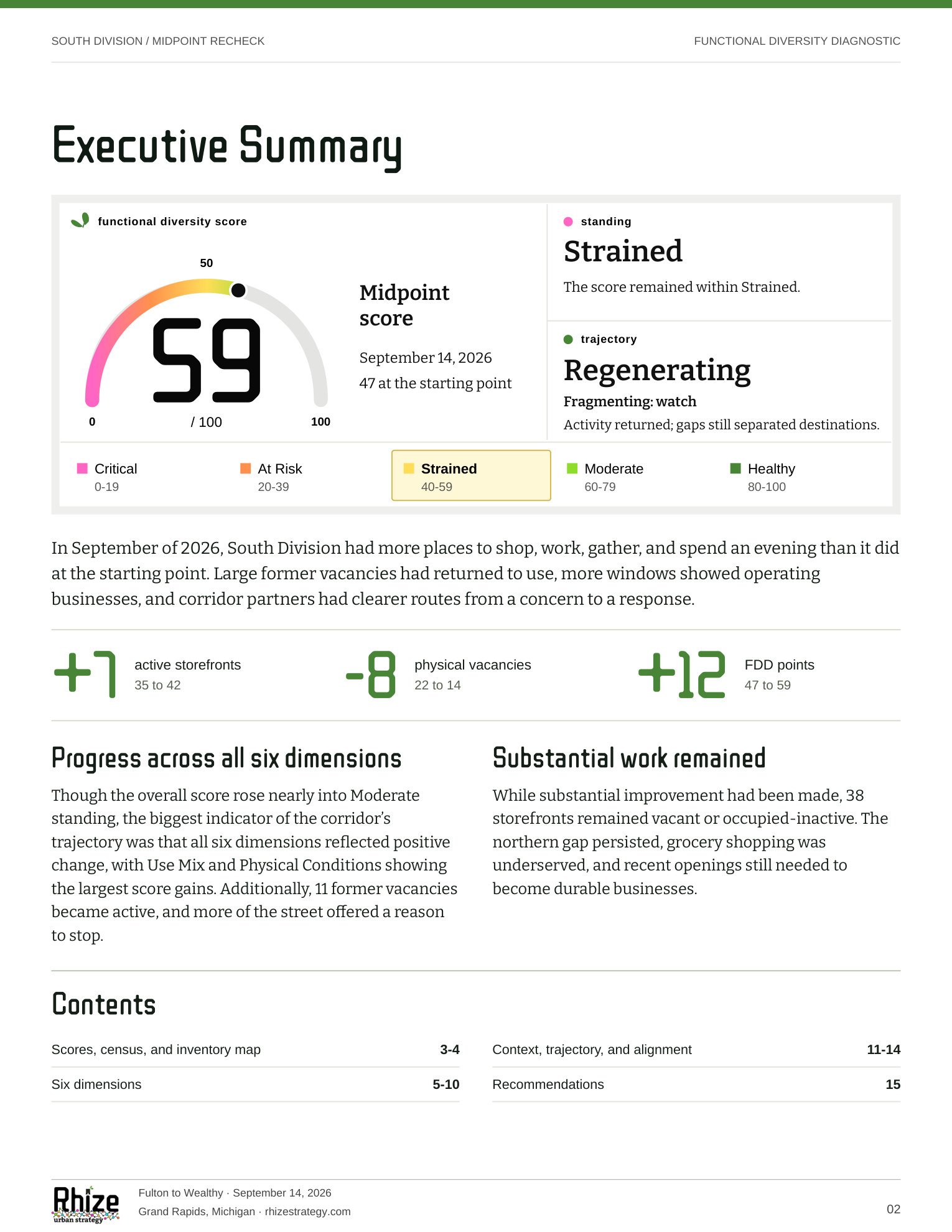
In September of 2026, South Division had more places to shop, work, gather, and spend an evening than it did
at the starting point. Large former vacancies had returned to use, more windows showed operating
businesses, and corridor partners had clearer routes from a concern to a response.
+7
active storefronts
35 to 42
-8
physical vacancies
22 to 14
+12
FDD points
47 to 59
Progress across all six dimensions
Though the overall score rose nearly into Moderate
standing, the biggest indicator of the corridor’s
trajectory was that all six dimensions reflected positive
change, with Use Mix and Physical Conditions showing
the largest score gains. Additionally, 11 former vacancies
became active, and more of the street offered a reason
to stop.
Substantial work remained
While substantial improvement had been made, 38
storefronts remained vacant or occupied-inactive. The
northern gap persisted, grocery shopping was
underserved, and recent openings still needed to
become durable businesses.
Contents
Scores, census, and inventory map
3-4
Six dimensions
5-10
Context, trajectory, and alignment
11-14
Recommendations
15
SOUTH DIVISION / MIDPOINT RECHECK
FUNCTIONAL DIVERSITY DIAGNOSTIC
Executive Summary
functional diversity score
59
0
50
100
/ 100
Midpoint
score
September 14, 2026
47 at the starting point
standing
trajectory
Strained
The score remained within Strained.
Regenerating
Fragmenting: watch
Activity returned; gaps still separated destinations.
Critical
0-19
At Risk
20-39
Strained
40-59
Moderate
60-79
Healthy
80-100
Fulton to Wealthy · September 14, 2026
Grand Rapids, Michigan · rhizestrategy.com
02
Read this page as text
DIMENSION
STARTING-
POINT
SCORE
STARTING-POINT
STANDING
MIDPOINT
SCORE
MIDPOINT
STANDING
CHANGE
Use Mix & Concentration
51
Strained
69
Moderate
+18
Economic Resilience
40
Strained
50
Strained
+10
Community Rootedness &
Governance
44
Strained
58
Strained
+14
Continuity & Gap Pattern
44
Strained
54
Strained
+10
Day-Part Activity Coverage
61
Moderate
66
Moderate
+5
Physical Conditions & Legacy Assets
39
At Risk
55
Strained
+16
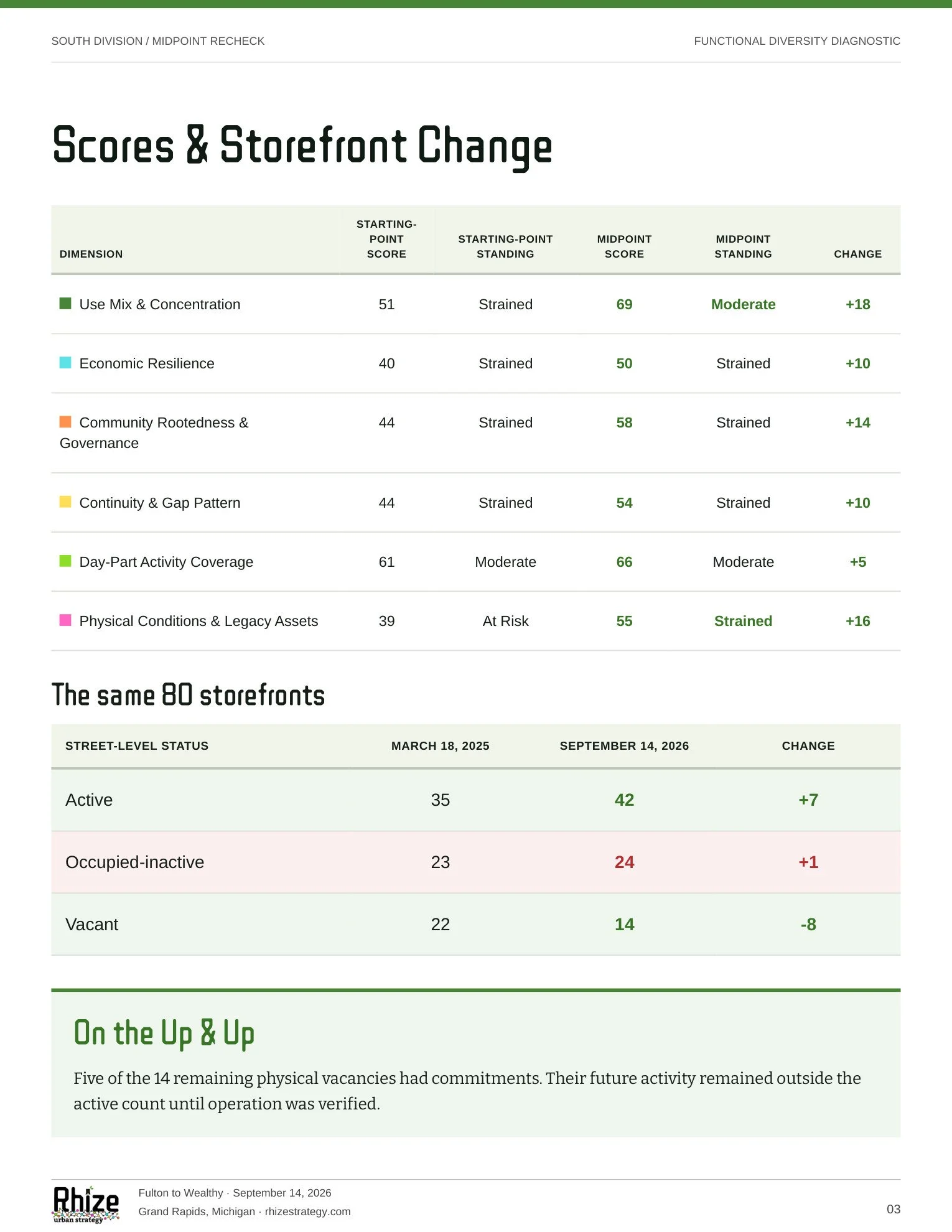
The same 80 storefronts
STREET-LEVEL STATUS
MARCH 18, 2025
SEPTEMBER 14, 2026
CHANGE
Active
35
42
+7
Occupied-inactive
23
24
+1
Vacant
22
14
-8
On the Up & Up
Five of the 14 remaining physical vacancies had commitments. Their future activity remained outside the
active count until operation was verified.
SOUTH DIVISION / MIDPOINT RECHECK
FUNCTIONAL DIVERSITY DIAGNOSTIC
Scores & Storefront Change
Fulton to Wealthy · September 14, 2026
Grand Rapids, Michigan · rhizestrategy.com
03
Read this page as text
September 14, 2026
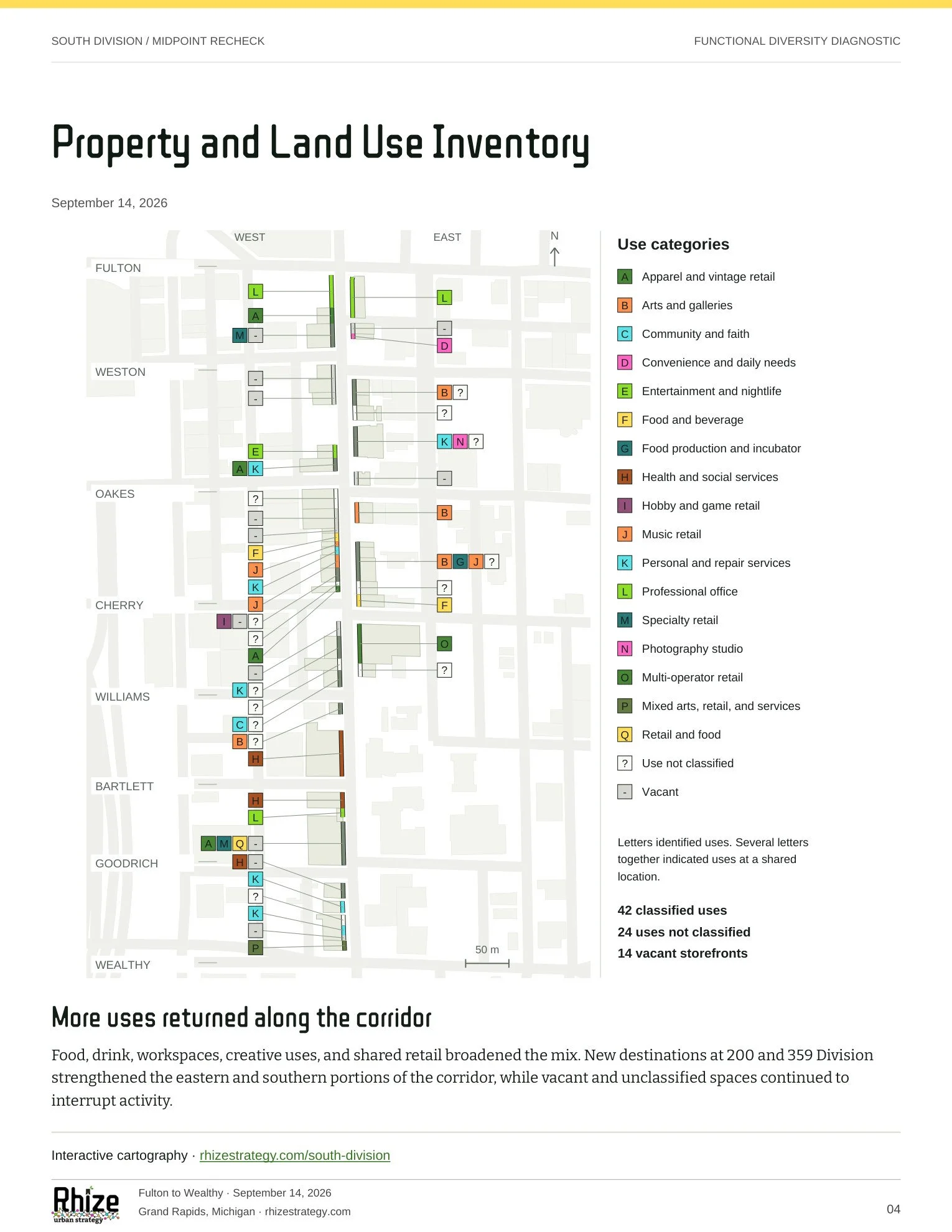
More uses returned along the corridor
Food, drink, workspaces, creative uses, and shared retail broadened the mix. New destinations at 200 and 359 Division
strengthened the eastern and southern portions of the corridor, while vacant and unclassified spaces continued to
interrupt activity.
Interactive cartography · rhizestrategy.com/south-division
SOUTH DIVISION / MIDPOINT RECHECK
FUNCTIONAL DIVERSITY DIAGNOSTIC
Property and Land Use Inventory
L
A
M
-
-
-
E
A K
?
-
-
F
J
K
J
I
-
?
?
A
-
K
?
?
C
?
B
?
H
H
L
A M Q
-
H
-
K
?
K
-
P
L
-
D
B
?
?
K N
?
-
B
B G
J
?
?
F
O
?
FULTON
WESTON
OAKES
CHERRY
WILLIAMS
BARTLETT
GOODRICH
WEALTHY
WEST
EAST
N
50 m
Use categories
A
Apparel and vintage retail
B
Arts and galleries
C
Community and faith
D
Convenience and daily needs
E
Entertainment and nightlife
F
Food and beverage
G
Food production and incubator
H
Health and social services
I
Hobby and game retail
J
Music retail
K
Personal and repair services
L
Professional office
M
Specialty retail
N
Photography studio
O
Multi-operator retail
P
Mixed arts, retail, and services
Q
Retail and food
?
Use not classified
-
Vacant
Letters identified uses. Several letters
together indicated uses at a shared
location.
42 classified uses
24 uses not classified
14 vacant storefronts
Fulton to Wealthy · September 14, 2026
Grand Rapids, Michigan · rhizestrategy.com
04
Read this page as text
STARTING POINT
51 / Strained
→
MIDPOINT
69 / Moderate
+18
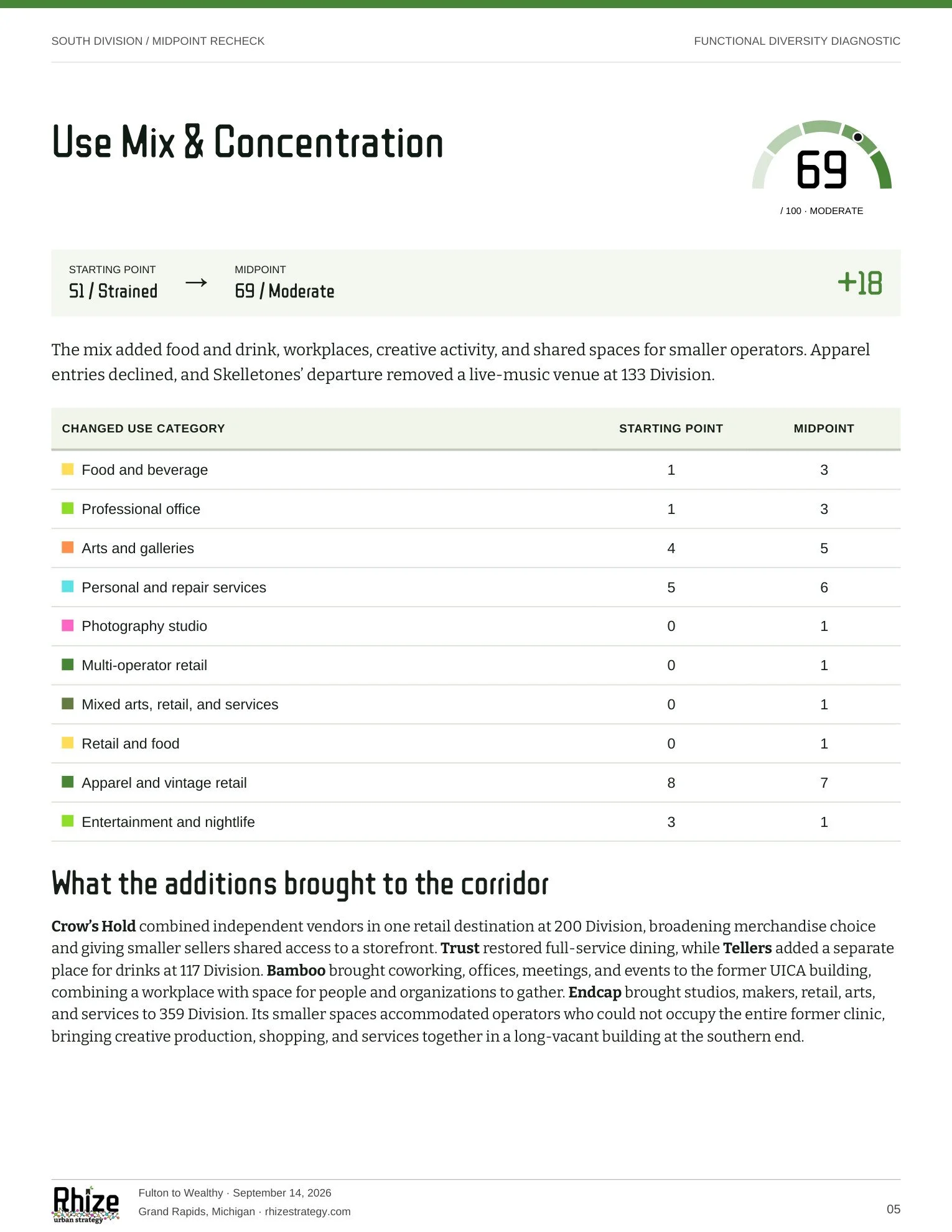
The mix added food and drink, workplaces, creative activity, and shared spaces for smaller operators. Apparel
entries declined, and Skelletones’ departure removed a live-music venue at 133 Division.
CHANGED USE CATEGORY
STARTING POINT
MIDPOINT
Food and beverage
1
3
Professional office
1
3
Arts and galleries
4
5
Personal and repair services
5
6
Photography studio
0
1
Multi-operator retail
0
1
Mixed arts, retail, and services
0
1
Retail and food
0
1
Apparel and vintage retail
8
7
Entertainment and nightlife
3
1
What the additions brought to the corridor
Crow’s Hold combined independent vendors in one retail destination at 200 Division, broadening merchandise choice
and giving smaller sellers shared access to a storefront. Trust restored full-service dining, while Tellers added a separate
place for drinks at 117 Division. Bamboo brought coworking, offices, meetings, and events to the former UICA building,
combining a workplace with space for people and organizations to gather. Endcap brought studios, makers, retail, arts,
and services to 359 Division. Its smaller spaces accommodated operators who could not occupy the entire former clinic,
bringing creative production, shopping, and services together in a long-vacant building at the southern end.
SOUTH DIVISION / MIDPOINT RECHECK
FUNCTIONAL DIVERSITY DIAGNOSTIC
Use Mix & Concentration
69
/ 100 · MODERATE
Fulton to Wealthy · September 14, 2026
Grand Rapids, Michigan · rhizestrategy.com
05
Read this page as text
STARTING POINT
40 / Strained
→
MIDPOINT
50 / Strained
+10
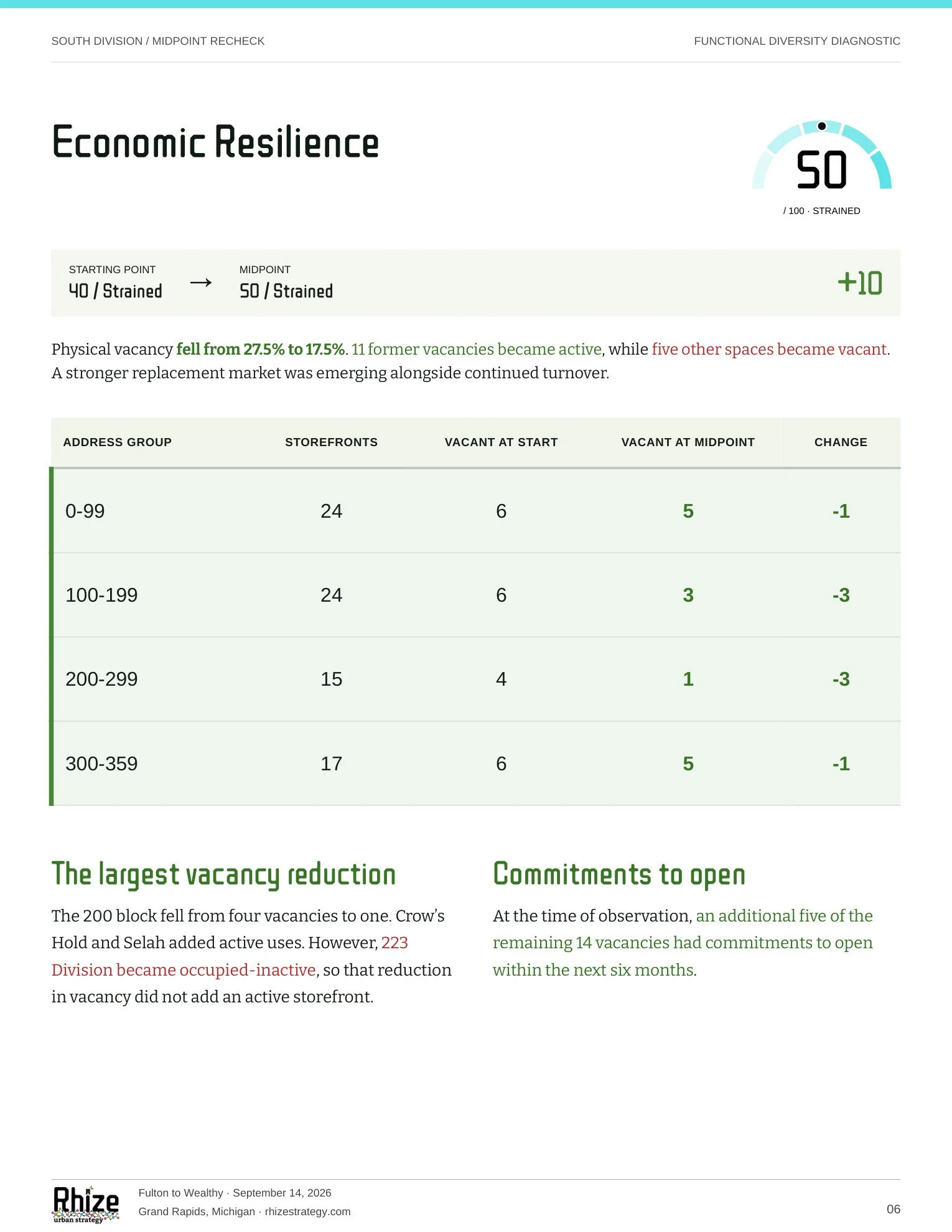
Physical vacancy fell from 27.5% to 17.5%. 11 former vacancies became active, while five other spaces became vacant.
A stronger replacement market was emerging alongside continued turnover.
ADDRESS GROUP
STOREFRONTS
VACANT AT START
VACANT AT MIDPOINT
CHANGE
0-99
24
6
5
-1
100-199
24
6
3
-3
200-299
15
4
1
-3
300-359
17
6
5
-1
The largest vacancy reduction
The 200 block fell from four vacancies to one. Crow’s
Hold and Selah added active uses. However, 223
Division became occupied-inactive, so that reduction
in vacancy did not add an active storefront.
Commitments to open
At the time of observation, an additional five of the
remaining 14 vacancies had commitments to open
within the next six months.
SOUTH DIVISION / MIDPOINT RECHECK
FUNCTIONAL DIVERSITY DIAGNOSTIC
Economic Resilience
50
/ 100 · STRAINED
Fulton to Wealthy · September 14, 2026
Grand Rapids, Michigan · rhizestrategy.com
06
Read this page as text
STARTING POINT
44 / Strained
→
MIDPOINT
58 / Strained
+14
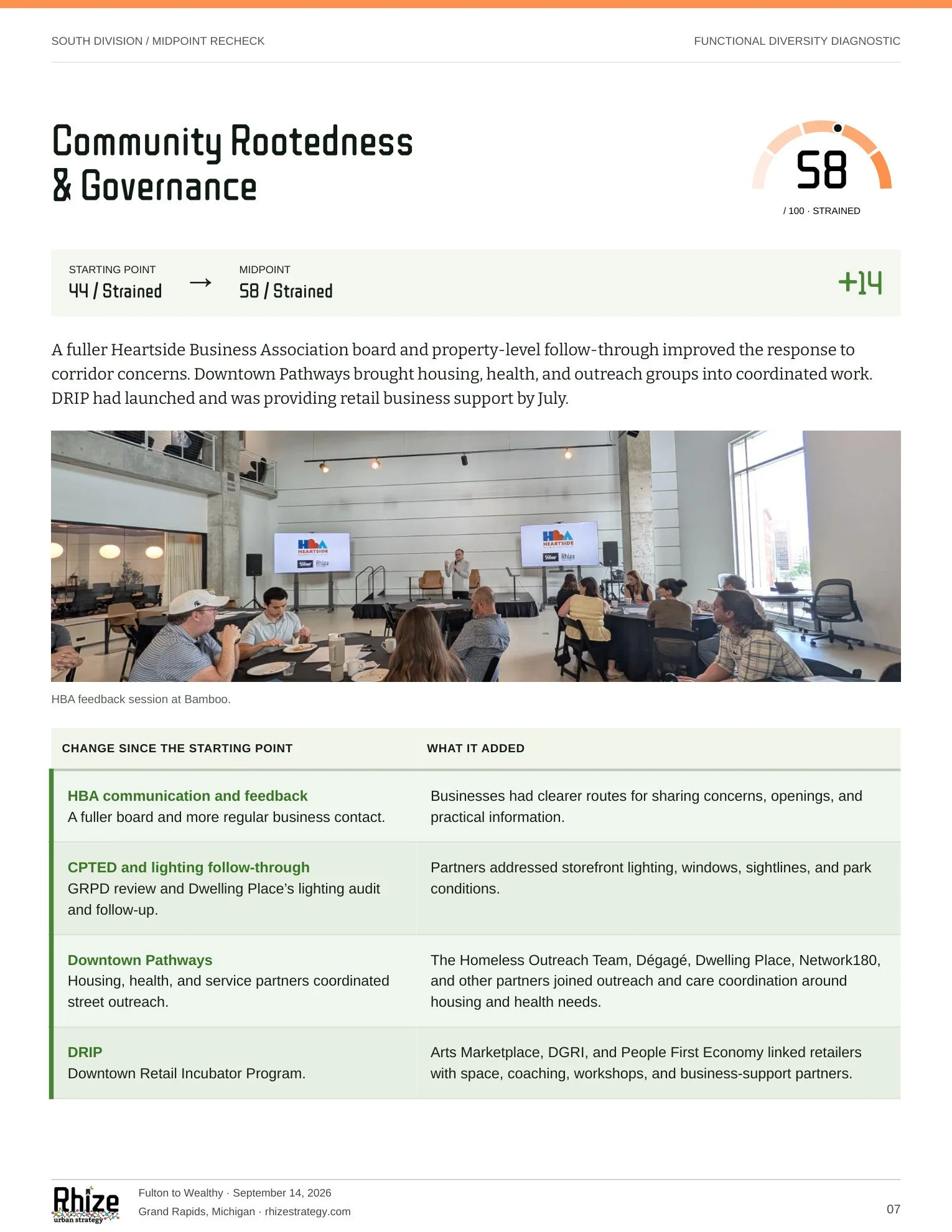
A fuller Heartside Business Association board and property-level follow-through improved the response to
corridor concerns. Downtown Pathways brought housing, health, and outreach groups into coordinated work.
DRIP had launched and was providing retail business support by July.
HBA feedback session at Bamboo.
CHANGE SINCE THE STARTING POINT
WHAT IT ADDED
HBA communication and feedback
A fuller board and more regular business contact.
Businesses had clearer routes for sharing concerns, openings, and
practical information.
CPTED and lighting follow-through
GRPD review and Dwelling Place’s lighting audit
and follow-up.
Partners addressed storefront lighting, windows, sightlines, and park
conditions.
Downtown Pathways
Housing, health, and service partners coordinated
street outreach.
The Homeless Outreach Team, Dégagé, Dwelling Place, Network180,
and other partners joined outreach and care coordination around
housing and health needs.
DRIP
Downtown Retail Incubator Program.
Arts Marketplace, DGRI, and People First Economy linked retailers
with space, coaching, workshops, and business-support partners.
SOUTH DIVISION / MIDPOINT RECHECK
FUNCTIONAL DIVERSITY DIAGNOSTIC
Community Rootedness
& Governance
58
/ 100 · STRAINED
Fulton to Wealthy · September 14, 2026
Grand Rapids, Michigan · rhizestrategy.com
07
Read this page as text
STARTING POINT
44 / Strained
→
MIDPOINT
54 / Strained
+10
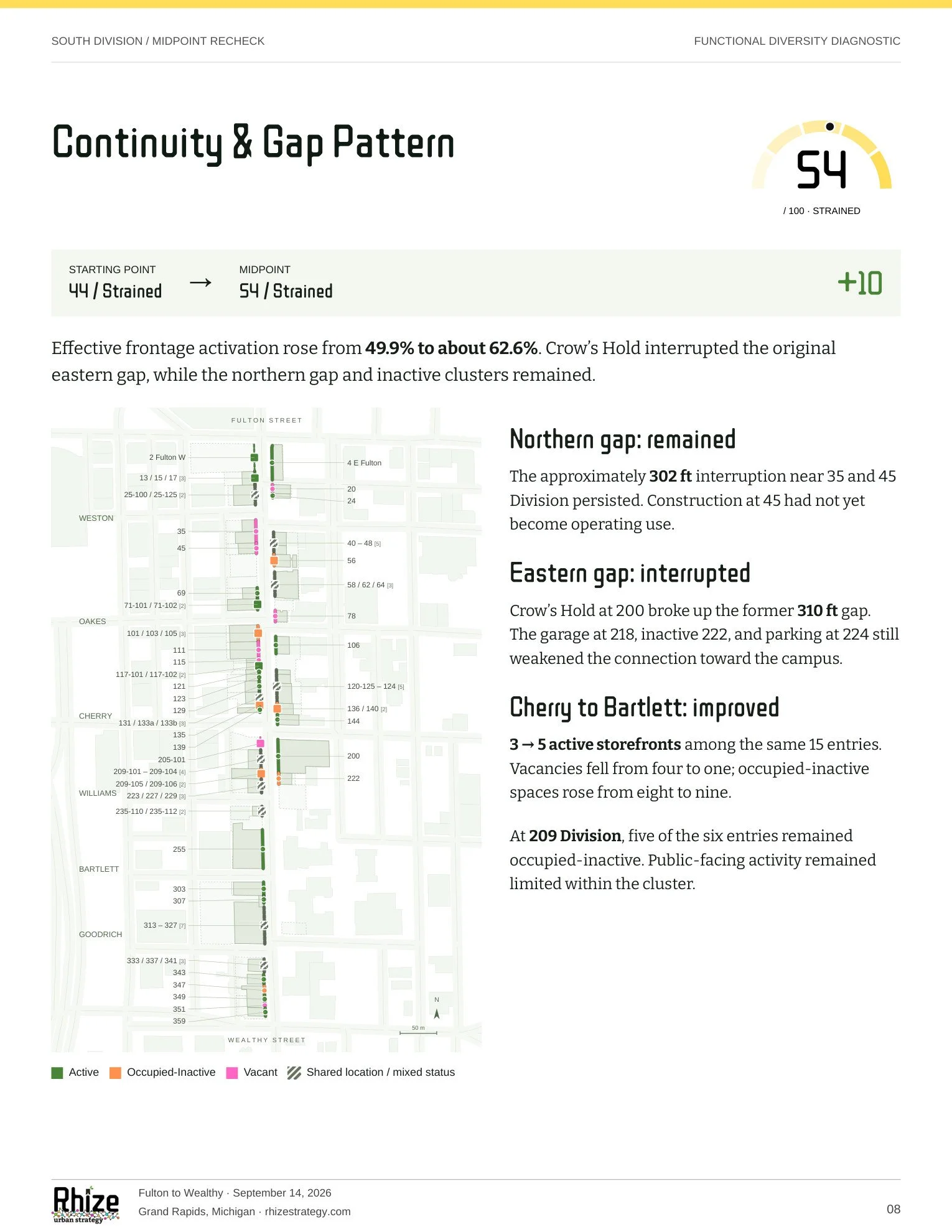
Effective frontage activation rose from 49.9% to about 62.6%. Crow’s Hold interrupted the original
eastern gap, while the northern gap and inactive clusters remained.
Northern gap: remained
The approximately 302 ft interruption near 35 and 45
Division persisted. Construction at 45 had not yet
become operating use.
Eastern gap: interrupted
Crow’s Hold at 200 broke up the former 310 ft gap.
The garage at 218, inactive 222, and parking at 224 still
weakened the connection toward the campus.
Cherry to Bartlett: improved
3 → 5 active storefronts among the same 15 entries.
Vacancies fell from four to one; occupied-inactive
spaces rose from eight to nine.
At 209 Division, five of the six entries remained
occupied-inactive. Public-facing activity remained
limited within the cluster.
Active
Occupied-Inactive
Vacant
Shared location / mixed status
SOUTH DIVISION / MIDPOINT RECHECK
FUNCTIONAL DIVERSITY DIAGNOSTIC
Continuity & Gap Pattern
54
/ 100 · STRAINED
2 Fulton W
13 / 15 / 17 [3]
25-100 / 25-125 [2]
35
45
69
71-101 / 71-102 [2]
101 / 103 / 105 [3]
111
115
117-101 / 117-102 [2]
121
123
129
131 / 133a / 133b [3]
135
139
205-101
209-101 – 209-104 [4]
209-105 / 209-106 [2]
223 / 227 / 229 [3]
235-110 / 235-112 [2]
255
303
307
313 – 327 [7]
333 / 337 / 341 [3]
343
347
349
351
359
4 E Fulton
20
24
40 – 48 [5]
56
58 / 62 / 64 [3]
78
106
120-125 – 124 [5]
136 / 140 [2]
144
200
222
N
F U L T O N S T R E E T
W E A L T H Y S T R E E T
50 m
OAKES
WESTON
CHERRY
GOODRICH
BARTLETT
WILLIAMS
Fulton to Wealthy · September 14, 2026
Grand Rapids, Michigan · rhizestrategy.com
08
Read this page as text
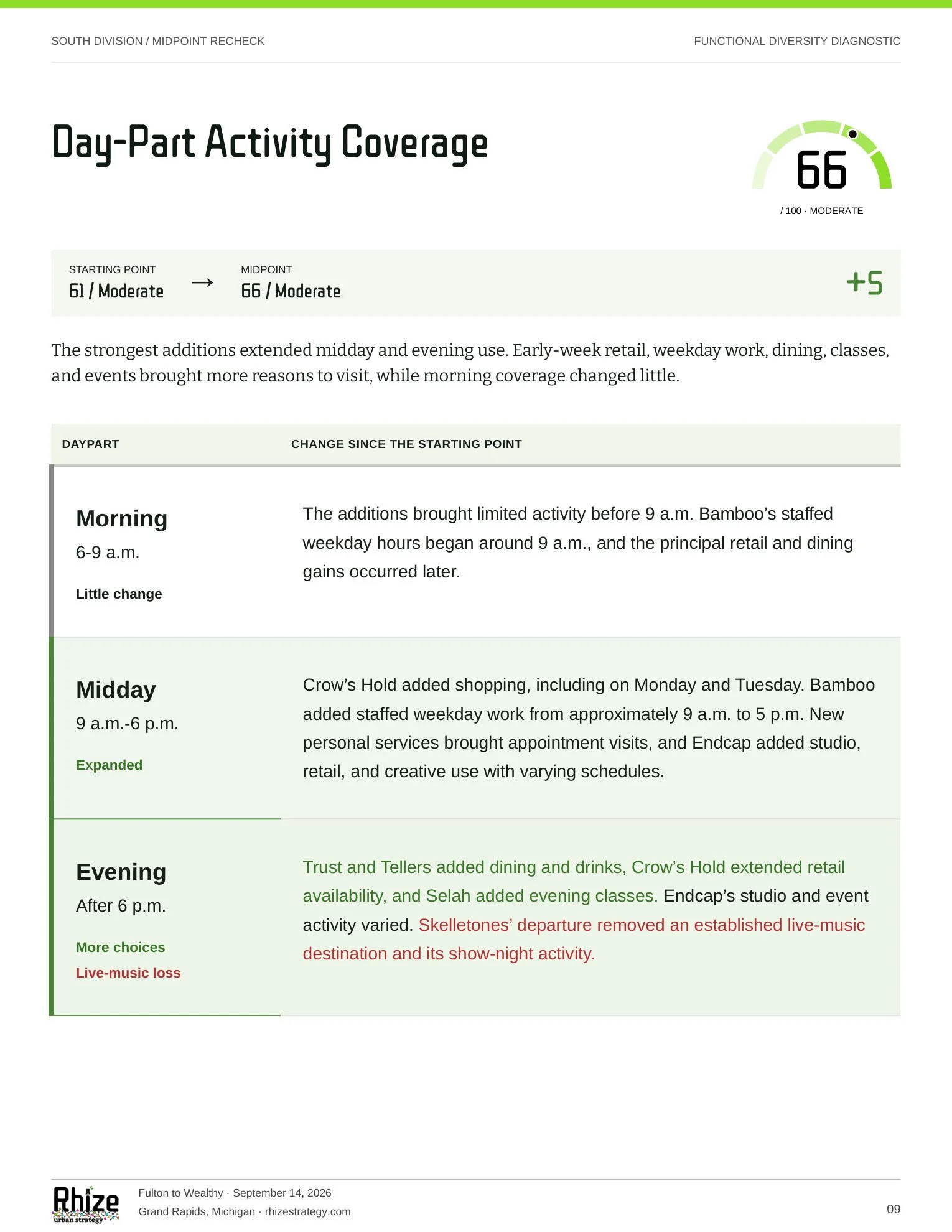
STARTING POINT
61 / Moderate
→
MIDPOINT
66 / Moderate
+5
The strongest additions extended midday and evening use. Early-week retail, weekday work, dining, classes,
and events brought more reasons to visit, while morning coverage changed little.
DAYPART
CHANGE SINCE THE STARTING POINT
Morning
6-9 a.m.
Little change
The additions brought limited activity before 9 a.m. Bamboo’s staffed
weekday hours began around 9 a.m., and the principal retail and dining
gains occurred later.
Midday
9 a.m.-6 p.m.
Expanded
Crow’s Hold added shopping, including on Monday and Tuesday. Bamboo
added staffed weekday work from approximately 9 a.m. to 5 p.m. New
personal services brought appointment visits, and Endcap added studio,
retail, and creative use with varying schedules.
Evening
After 6 p.m.
More choices
Live-music loss
Trust and Tellers added dining and drinks, Crow’s Hold extended retail
availability, and Selah added evening classes. Endcap’s studio and event
activity varied. Skelletones’ departure removed an established live-music
destination and its show-night activity.
SOUTH DIVISION / MIDPOINT RECHECK
FUNCTIONAL DIVERSITY DIAGNOSTIC
Day-Part Activity Coverage
66
/ 100 · MODERATE
Fulton to Wealthy · September 14, 2026
Grand Rapids, Michigan · rhizestrategy.com
09
Read this page as text
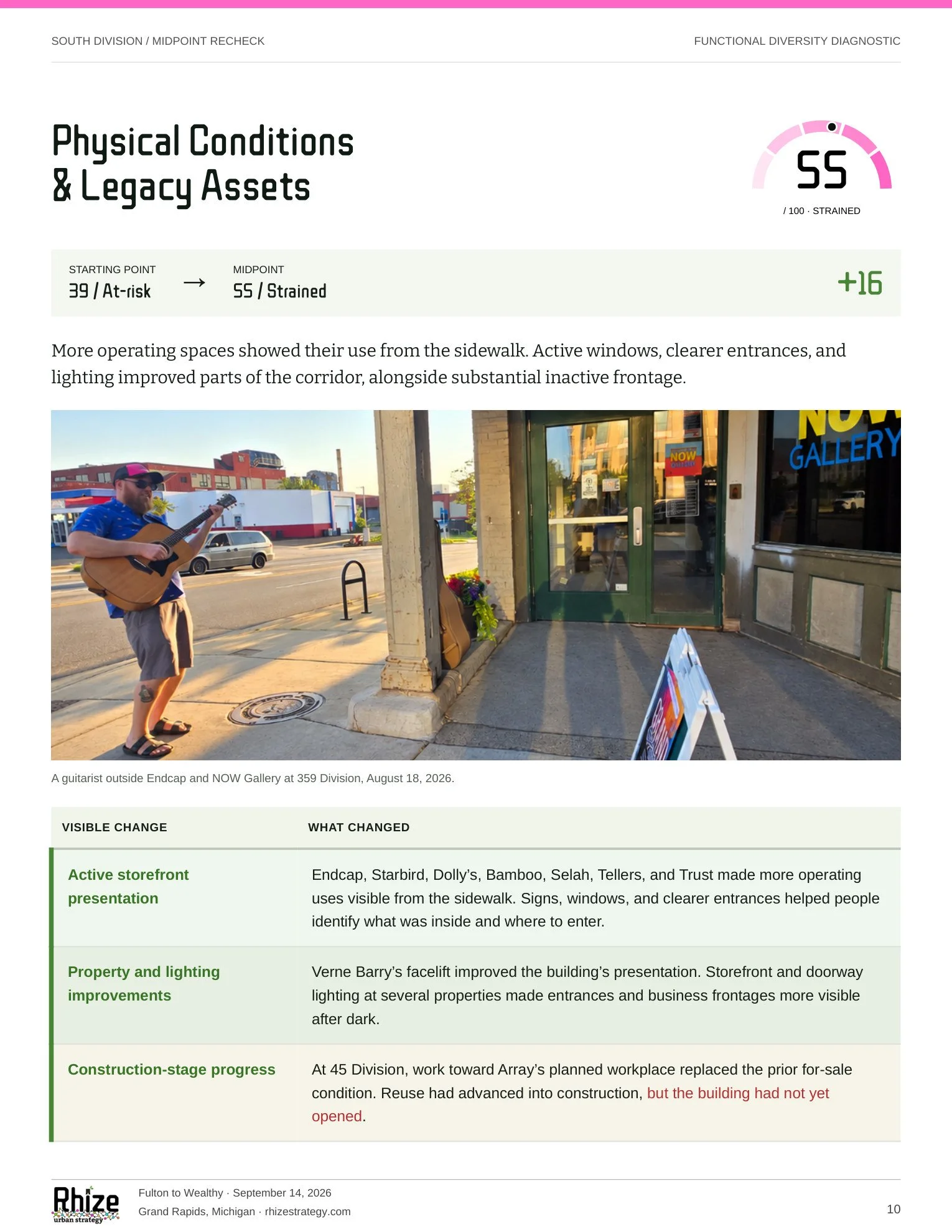
STARTING POINT
39 / At-risk
→
MIDPOINT
55 / Strained
+16
More operating spaces showed their use from the sidewalk. Active windows, clearer entrances, and
lighting improved parts of the corridor, alongside substantial inactive frontage.
A guitarist outside Endcap and NOW Gallery at 359 Division, August 18, 2026.
VISIBLE CHANGE
WHAT CHANGED
Active storefront
presentation
Endcap, Starbird, Dolly’s, Bamboo, Selah, Tellers, and Trust made more operating
uses visible from the sidewalk. Signs, windows, and clearer entrances helped people
identify what was inside and where to enter.
Property and lighting
improvements
Verne Barry’s facelift improved the building’s presentation. Storefront and doorway
lighting at several properties made entrances and business frontages more visible
after dark.
Construction-stage progress
At 45 Division, work toward Array’s planned workplace replaced the prior for-sale
condition. Reuse had advanced into construction, but the building had not yet
opened.
SOUTH DIVISION / MIDPOINT RECHECK
FUNCTIONAL DIVERSITY DIAGNOSTIC
Physical Conditions
& Legacy Assets
55
/ 100 · STRAINED
Fulton to Wealthy · September 14, 2026
Grand Rapids, Michigan · rhizestrategy.com
10
Read this page as text
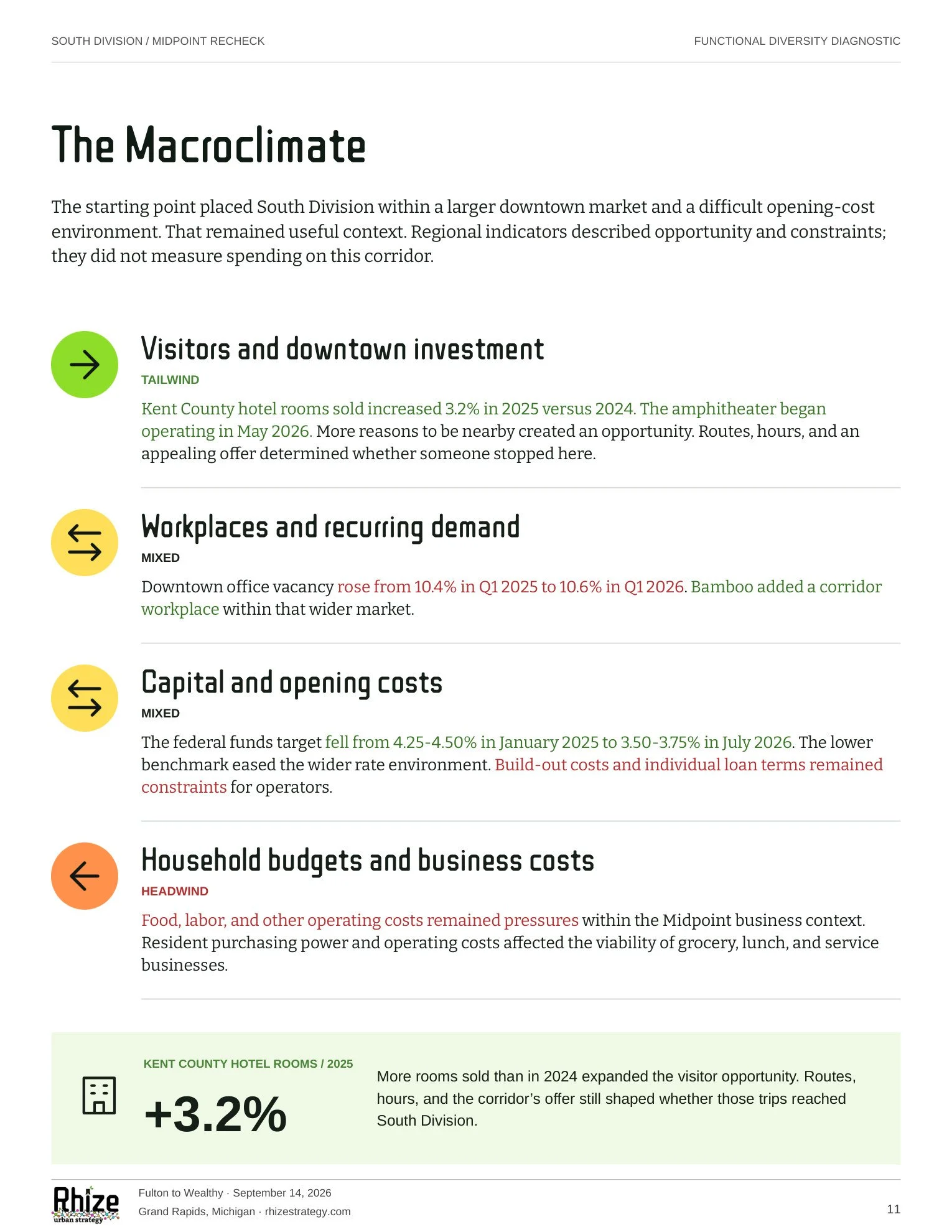
The starting point placed South Division within a larger downtown market and a difficult opening-cost
environment. That remained useful context. Regional indicators described opportunity and constraints;
they did not measure spending on this corridor.
Visitors and downtown investment
TAILWIND
Kent County hotel rooms sold increased 3.2% in 2025 versus 2024. The amphitheater began
operating in May 2026. More reasons to be nearby created an opportunity. Routes, hours, and an
appealing offer determined whether someone stopped here.
Workplaces and recurring demand
MIXED
Downtown office vacancy rose from 10.4% in Q1 2025 to 10.6% in Q1 2026. Bamboo added a corridor
workplace within that wider market.
Capital and opening costs
MIXED
The federal funds target fell from 4.25-4.50% in January 2025 to 3.50-3.75% in July 2026. The lower
benchmark eased the wider rate environment. Build-out costs and individual loan terms remained
constraints for operators.
Household budgets and business costs
HEADWIND
Food, labor, and other operating costs remained pressures within the Midpoint business context.
Resident purchasing power and operating costs affected the viability of grocery, lunch, and service
businesses.
KENT COUNTY HOTEL ROOMS / 2025
+3.2%
More rooms sold than in 2024 expanded the visitor opportunity. Routes,
hours, and the corridor’s offer still shaped whether those trips reached
South Division.
SOUTH DIVISION / MIDPOINT RECHECK
FUNCTIONAL DIVERSITY DIAGNOSTIC
The Macroclimate
Fulton to Wealthy · September 14, 2026
Grand Rapids, Michigan · rhizestrategy.com
11
Read this page as text
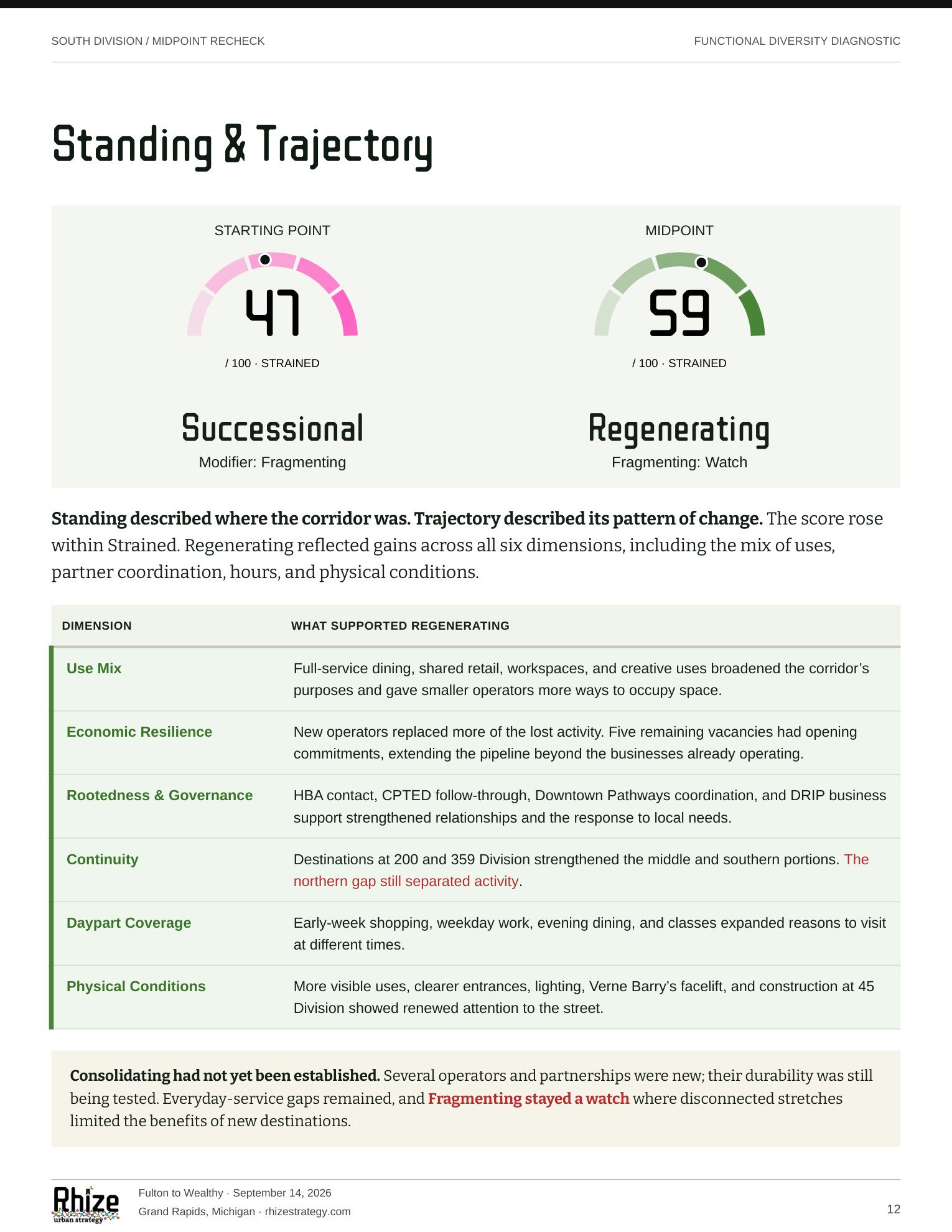
STARTING POINT
Successional
Modifier: Fragmenting
MIDPOINT
Regenerating
Fragmenting: Watch
Standing described where the corridor was. Trajectory described its pattern of change. The score rose
within Strained. Regenerating reflected gains across all six dimensions, including the mix of uses,
partner coordination, hours, and physical conditions.
DIMENSION
WHAT SUPPORTED REGENERATING
Use Mix
Full-service dining, shared retail, workspaces, and creative uses broadened the corridor’s
purposes and gave smaller operators more ways to occupy space.
Economic Resilience
New operators replaced more of the lost activity. Five remaining vacancies had opening
commitments, extending the pipeline beyond the businesses already operating.
Rootedness & Governance
HBA contact, CPTED follow-through, Downtown Pathways coordination, and DRIP business
support strengthened relationships and the response to local needs.
Continuity
Destinations at 200 and 359 Division strengthened the middle and southern portions. The
northern gap still separated activity.
Daypart Coverage
Early-week shopping, weekday work, evening dining, and classes expanded reasons to visit
at different times.
Physical Conditions
More visible uses, clearer entrances, lighting, Verne Barry’s facelift, and construction at 45
Division showed renewed attention to the street.
Consolidating had not yet been established. Several operators and partnerships were new; their durability was still
being tested. Everyday-service gaps remained, and Fragmenting stayed a watch where disconnected stretches
limited the benefits of new destinations.
SOUTH DIVISION / MIDPOINT RECHECK
FUNCTIONAL DIVERSITY DIAGNOSTIC
Standing & Trajectory
47
/ 100 · STRAINED
59
/ 100 · STRAINED
Fulton to Wealthy · September 14, 2026
Grand Rapids, Michigan · rhizestrategy.com
12
Read this page as text
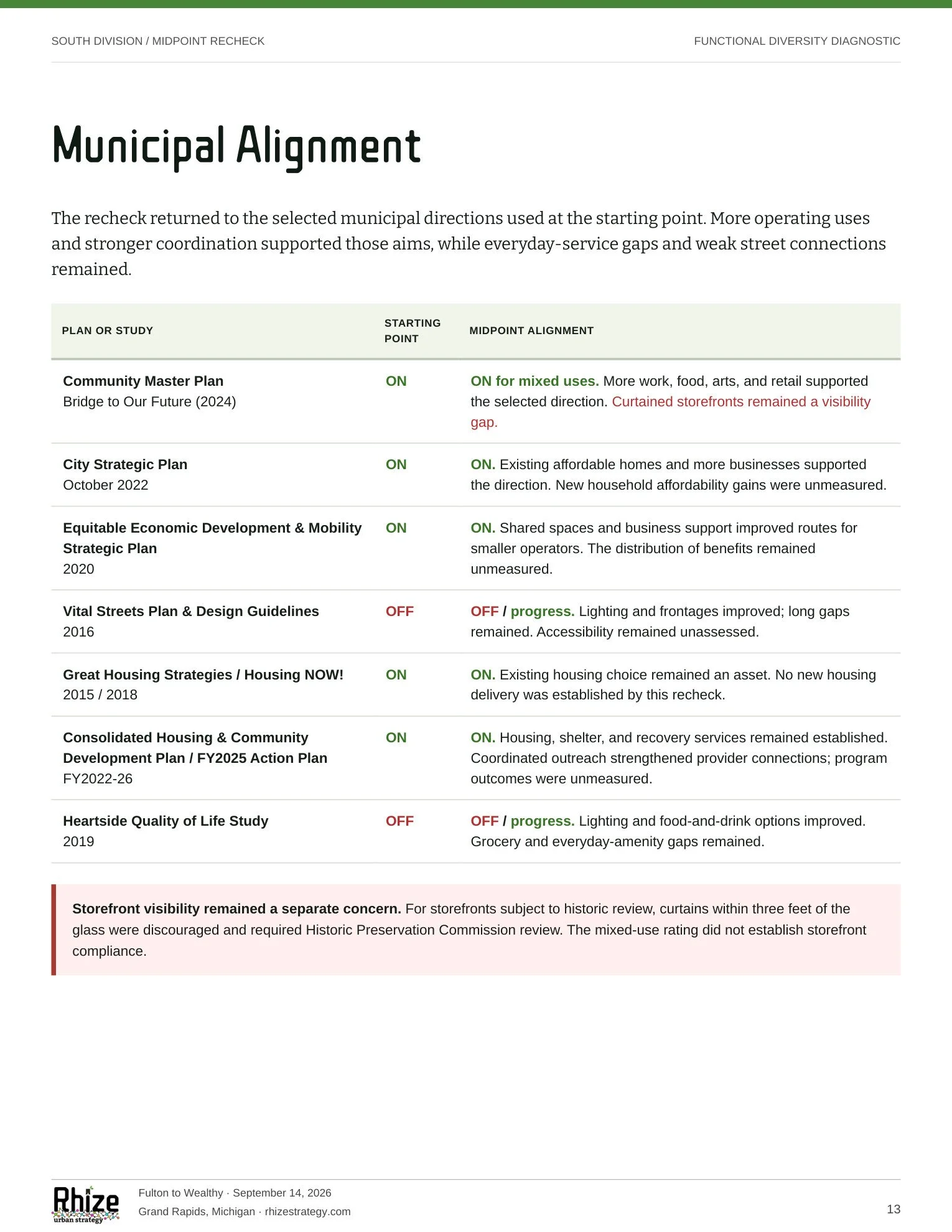
The recheck returned to the selected municipal directions used at the starting point. More operating uses
and stronger coordination supported those aims, while everyday-service gaps and weak street connections
remained.
PLAN OR STUDY
STARTING
POINT
MIDPOINT ALIGNMENT
Community Master Plan
Bridge to Our Future (2024)
ON
ON for mixed uses. More work, food, arts, and retail supported
the selected direction. Curtained storefronts remained a visibility
gap.
City Strategic Plan
October 2022
ON
ON. Existing affordable homes and more businesses supported
the direction. New household affordability gains were unmeasured.
Equitable Economic Development & Mobility
Strategic Plan
2020
ON
ON. Shared spaces and business support improved routes for
smaller operators. The distribution of benefits remained
unmeasured.
Vital Streets Plan & Design Guidelines
2016
OFF
OFF / progress. Lighting and frontages improved; long gaps
remained. Accessibility remained unassessed.
Great Housing Strategies / Housing NOW!
2015 / 2018
ON
ON. Existing housing choice remained an asset. No new housing
delivery was established by this recheck.
Consolidated Housing & Community
Development Plan / FY2025 Action Plan
FY2022-26
ON
ON. Housing, shelter, and recovery services remained established.
Coordinated outreach strengthened provider connections; program
outcomes were unmeasured.
Heartside Quality of Life Study
2019
OFF
OFF / progress. Lighting and food-and-drink options improved.
Grocery and everyday-amenity gaps remained.
Storefront visibility remained a separate concern. For storefronts subject to historic review, curtains within three feet of the
glass were discouraged and required Historic Preservation Commission review. The mixed-use rating did not establish storefront
compliance.
SOUTH DIVISION / MIDPOINT RECHECK
FUNCTIONAL DIVERSITY DIAGNOSTIC
Municipal Alignment
Fulton to Wealthy · September 14, 2026
Grand Rapids, Michigan · rhizestrategy.com
13
Read this page as text
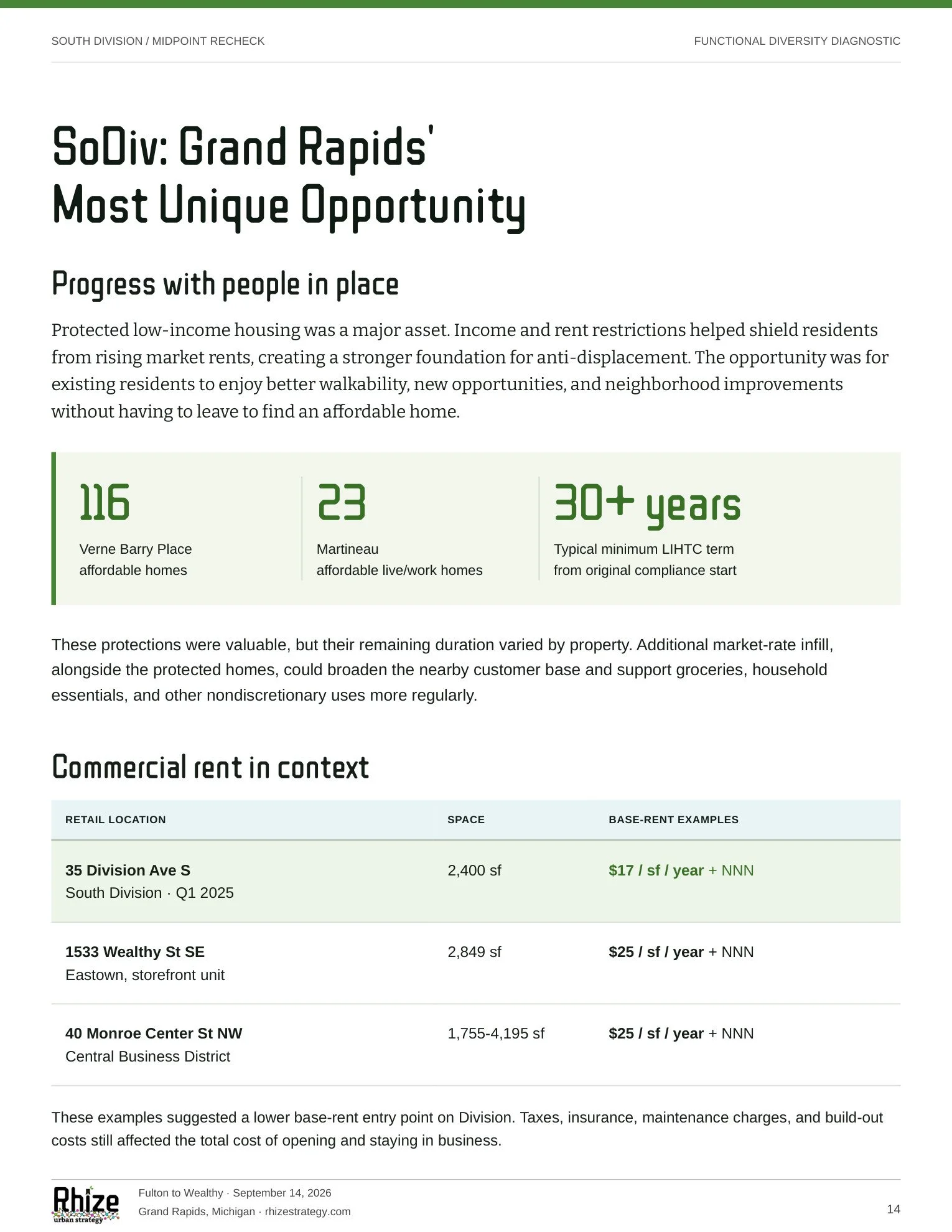
Progress with people in place
Protected low-income housing was a major asset. Income and rent restrictions helped shield residents
from rising market rents, creating a stronger foundation for anti-displacement. The opportunity was for
existing residents to enjoy better walkability, new opportunities, and neighborhood improvements
without having to leave to find an affordable home.
116
Verne Barry Place
affordable homes
23
Martineau
affordable live/work homes
30+ years
Typical minimum LIHTC term
from original compliance start
These protections were valuable, but their remaining duration varied by property. Additional market-rate infill,
alongside the protected homes, could broaden the nearby customer base and support groceries, household
essentials, and other nondiscretionary uses more regularly.
Commercial rent in context
RETAIL LOCATION
SPACE
BASE-RENT EXAMPLES
35 Division Ave S
South Division · Q1 2025
2,400 sf
$17 / sf / year + NNN
1533 Wealthy St SE
Eastown, storefront unit
2,849 sf
$25 / sf / year + NNN
40 Monroe Center St NW
Central Business District
1,755-4,195 sf
$25 / sf / year + NNN
These examples suggested a lower base-rent entry point on Division. Taxes, insurance, maintenance charges, and build-out
costs still affected the total cost of opening and staying in business.
SOUTH DIVISION / MIDPOINT RECHECK
FUNCTIONAL DIVERSITY DIAGNOSTIC
SoDiv: Grand Rapids'
Most Unique Opportunity
Fulton to Wealthy · September 14, 2026
Grand Rapids, Michigan · rhizestrategy.com
14
Read this page as text
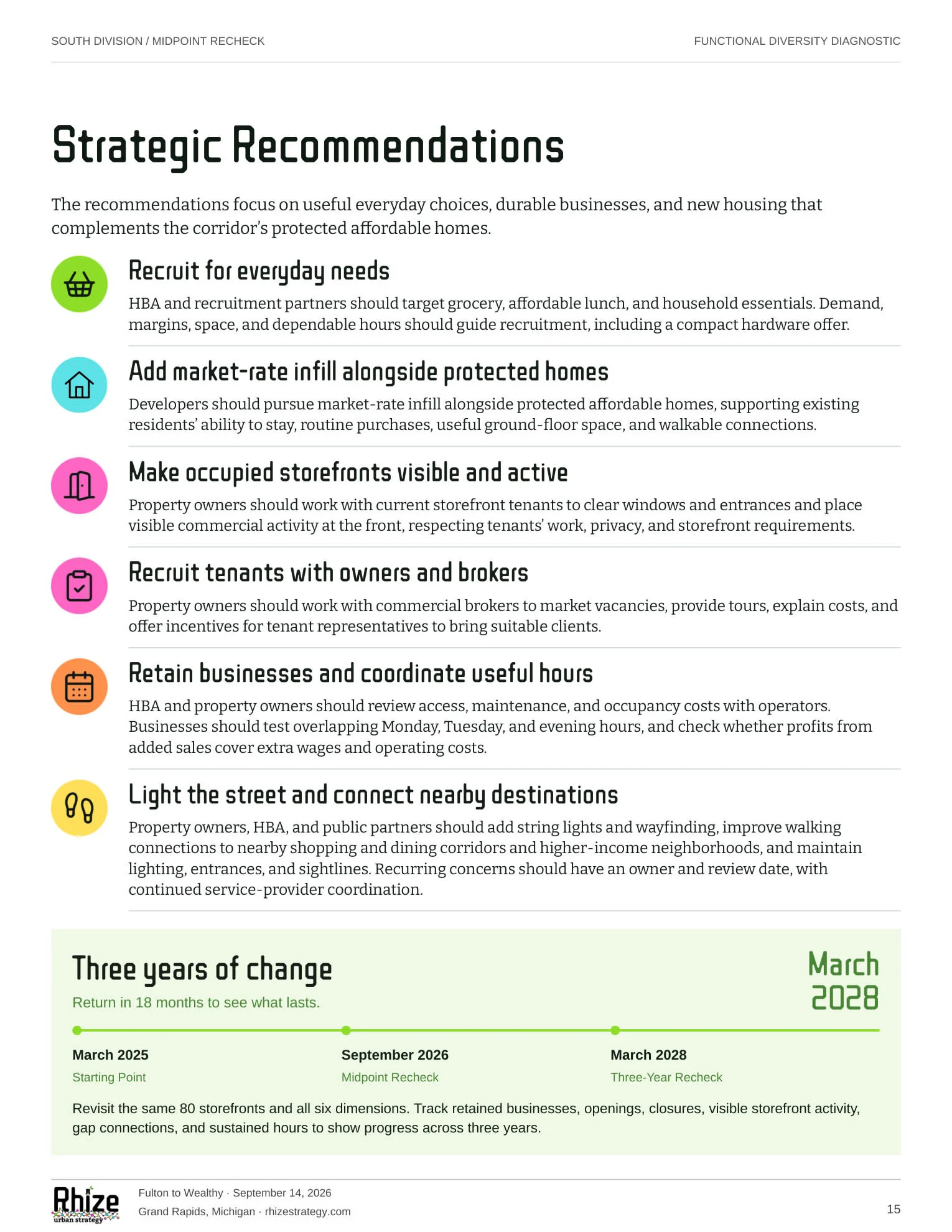
The recommendations focus on useful everyday choices, durable businesses, and new housing that
complements the corridor’s protected affordable homes.
Recruit for everyday needs
HBA and recruitment partners should target grocery, affordable lunch, and household essentials. Demand,
margins, space, and dependable hours should guide recruitment, including a compact hardware offer.
Add market-rate infill alongside protected homes
Developers should pursue market-rate infill alongside protected affordable homes, supporting existing
residents’ ability to stay, routine purchases, useful ground-floor space, and walkable connections.
Make occupied storefronts visible and active
Property owners should work with current storefront tenants to clear windows and entrances and place
visible commercial activity at the front, respecting tenants’ work, privacy, and storefront requirements.
Recruit tenants with owners and brokers
Property owners should work with commercial brokers to market vacancies, provide tours, explain costs, and
offer incentives for tenant representatives to bring suitable clients.
Retain businesses and coordinate useful hours
HBA and property owners should review access, maintenance, and occupancy costs with operators.
Businesses should test overlapping Monday, Tuesday, and evening hours, and check whether profits from
added sales cover extra wages and operating costs.
Light the street and connect nearby destinations
Property owners, HBA, and public partners should add string lights and wayfinding, improve walking
connections to nearby shopping and dining corridors and higher-income neighborhoods, and maintain
lighting, entrances, and sightlines. Recurring concerns should have an owner and review date, with
continued service-provider coordination.
Three years of change
Return in 18 months to see what lasts.
March
2028
Revisit the same 80 storefronts and all six dimensions. Track retained businesses, openings, closures, visible storefront activity,
gap connections, and sustained hours to show progress across three years.
SOUTH DIVISION / MIDPOINT RECHECK
FUNCTIONAL DIVERSITY DIAGNOSTIC
Strategic Recommendations
March 2025
Starting Point
September 2026
Midpoint Recheck
March 2028
Three-Year Recheck
Fulton to Wealthy · September 14, 2026
Grand Rapids, Michigan · rhizestrategy.com
15
Keep a copy
Enter your name and email below for immediate access to the PDF. Rhize records these details to understand who is using the report. This does not subscribe you to a mailing list.