
Fancy’s work
on South Division
Read the case study here. Use the page controls to move through it.
of 10
Read this page as text
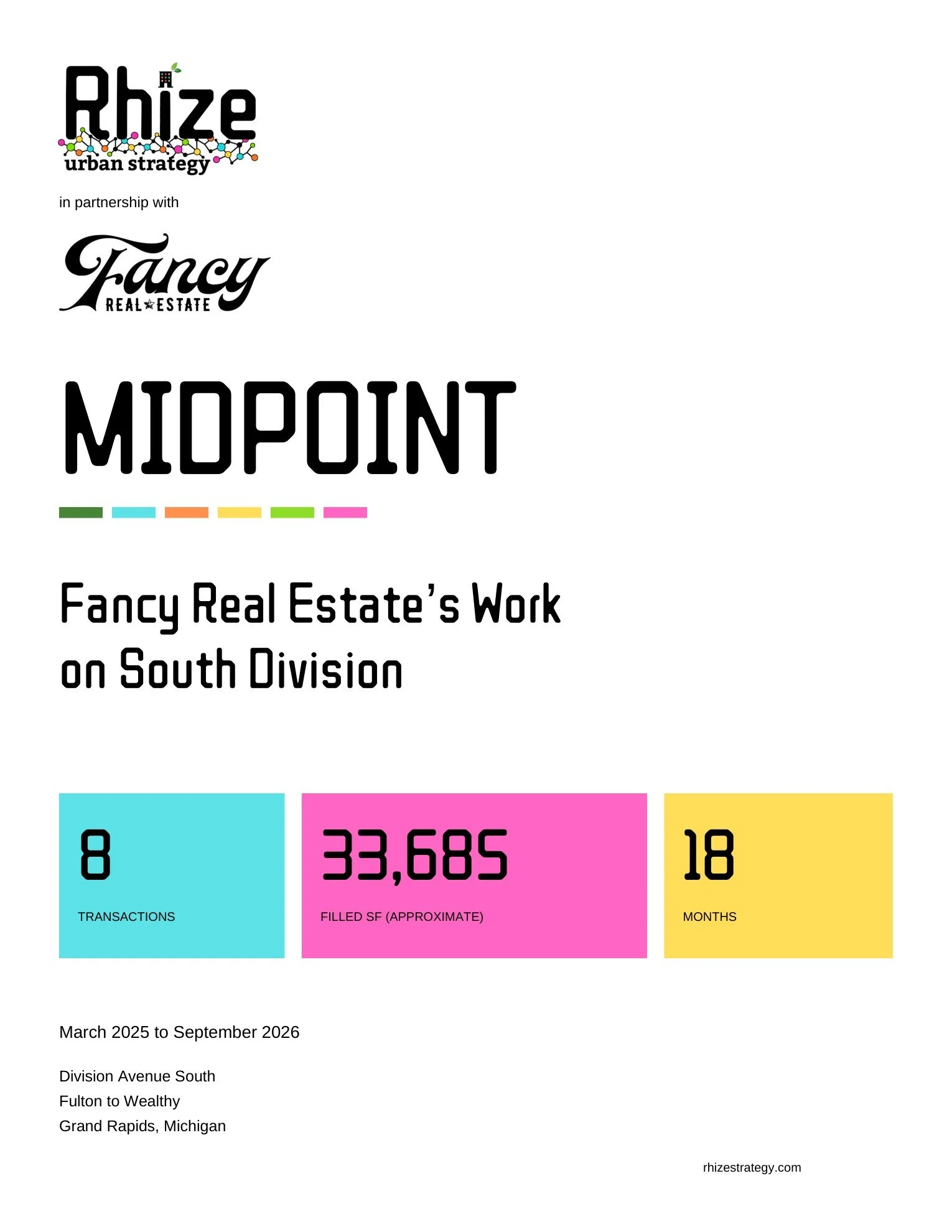
MIDPOINT
Fancy Real Estate’s Work
on South Division
8
TRANSACTIONS
33,685
FILLED SF (APPROXIMATE)
18
MONTHS
March 2025 to September 2026
Division Avenue South
Fulton to Wealthy
Grand Rapids, Michigan
rhizestrategy.com
in partnership with
Read this page as text
RHIZE / SOUTH DIVISION
MIDPOINT CASE STUDY
Fancy Real Estate’s Work
FULTON TO WEALTHY / GRAND RAPIDS
on South Division
8
TRANSACTIONS
33,685
FILLED SF (APPROXIMATE)
18
MONTHS
The work crossed different owners, seven
leases and one acquisition, and three
brokerage positions: landlord representation,
tenant and transaction representation, and
buyer representation.
The spaces ranged from a 450 sf historic
storefront to a 13,179 sf former restaurant and
an 11,674 sf former clinic. Each required a
workable match between the building, its
owner, and the people who would use it. That
meant some degree of reuse or adaptation, an
assessment of what the business would add
to the corridor, and whether South Division
could support the business in return.
South Division already had a creative
economy, independent merchants, housing,
institutions, and cultural organizations. Fancy
worked within that established district,
helping businesses find space and owners
find uses their buildings could accommodate.
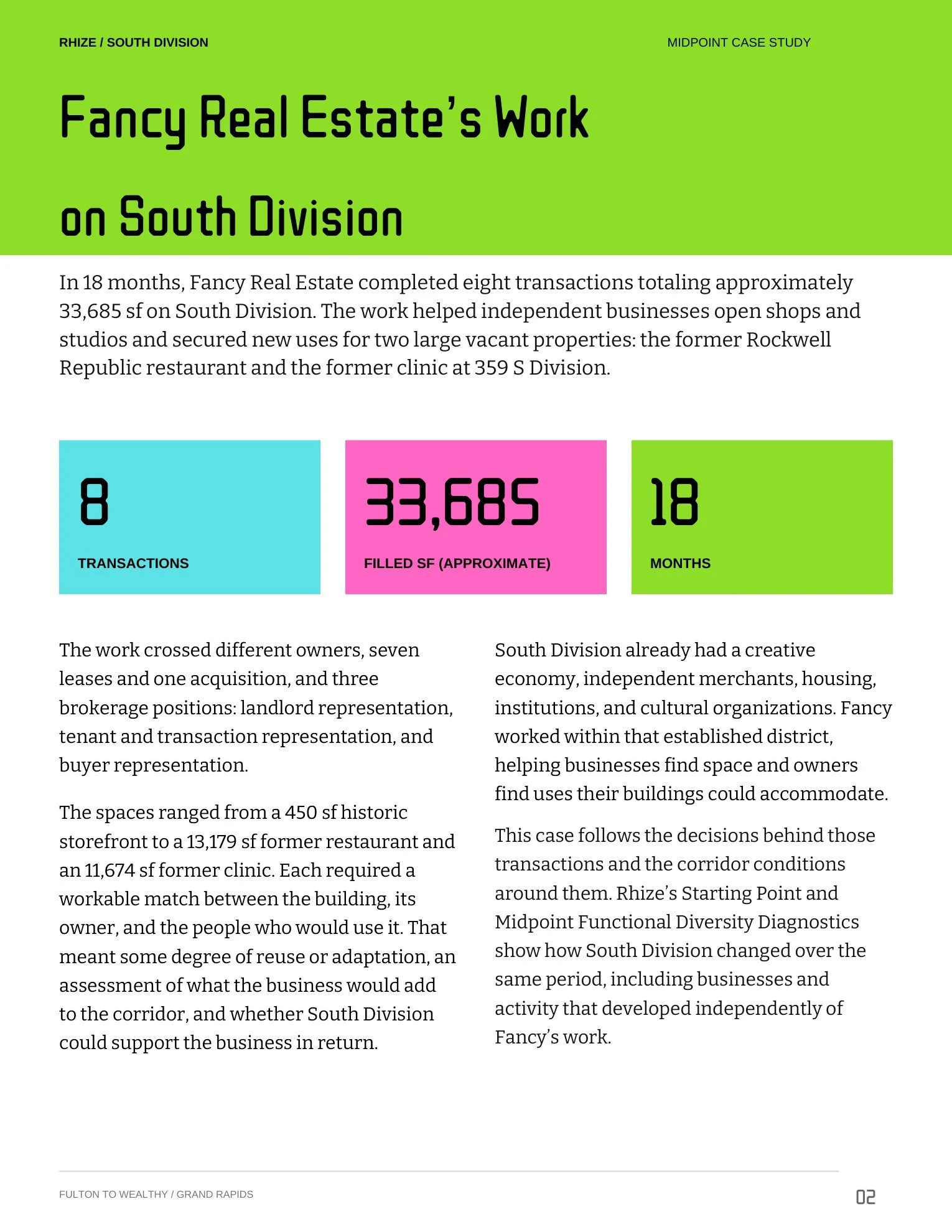
In 18 months, Fancy Real Estate completed eight transactions totaling approximately
33,685 sf on South Division. The work helped independent businesses open shops and
studios and secured new uses for two large vacant properties: the former Rockwell
Republic restaurant and the former clinic at 359 S Division.
This case follows the decisions behind those
transactions and the corridor conditions
around them. Rhize’s Starting Point and
Midpoint Functional Diversity Diagnostics
show how South Division changed over the
same period, including businesses and
activity that developed independently of
Fancy’s work.
02
Read this page as text
RHIZE / SOUTH DIVISION
MIDPOINT CASE STUDY
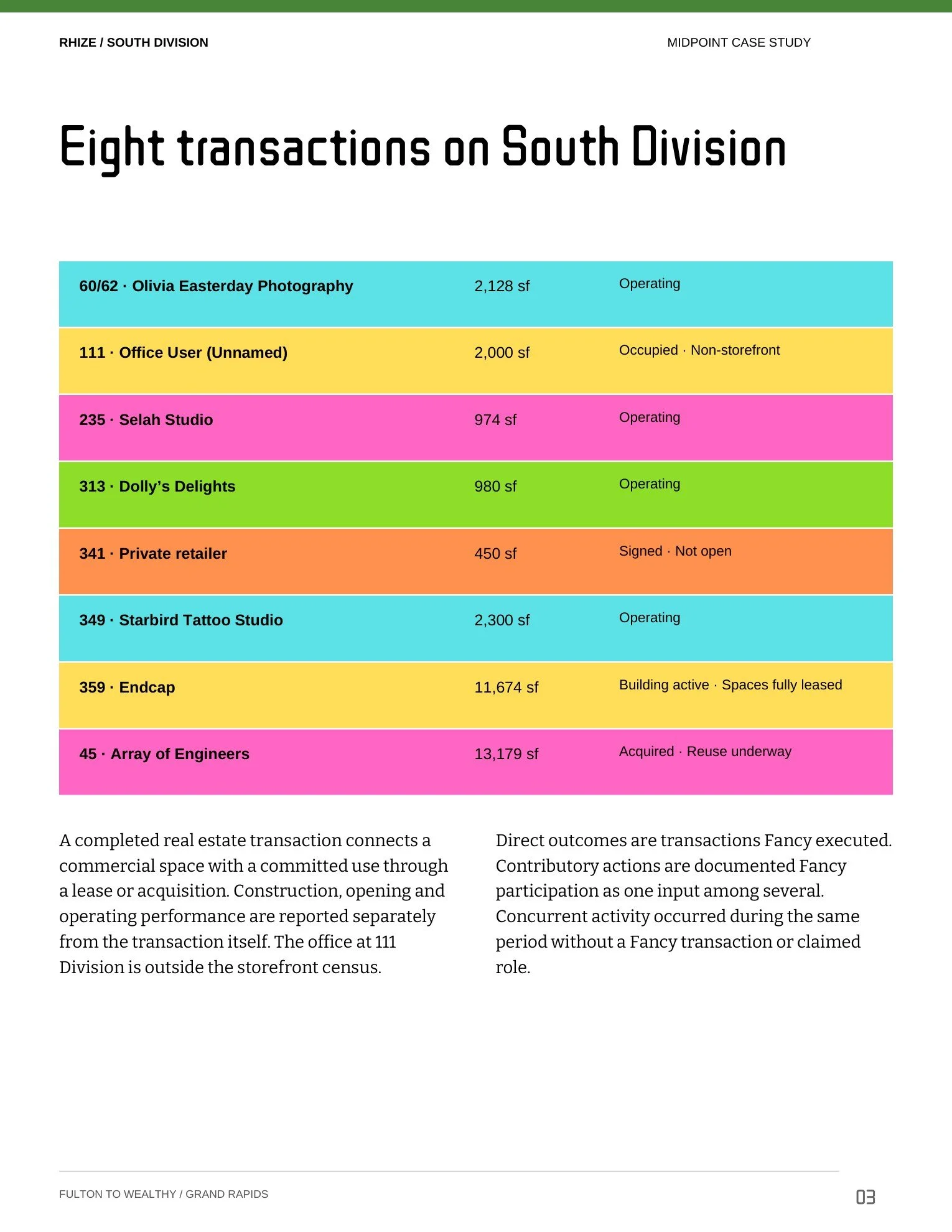
Eight transactions on South Division
60/62 · Olivia Easterday Photography
2,128 sf
Operating
111 · Office User (Unnamed)
2,000 sf
Occupied · Non-storefront
235 · Selah Studio
974 sf
Operating
313 · Dolly’s Delights
980 sf
Operating
341 · Private retailer
450 sf
Signed · Not open
349 · Starbird Tattoo Studio
2,300 sf
Operating
359 · Endcap
11,674 sf
Building active · Spaces fully leased
45 · Array of Engineers
13,179 sf
Acquired · Reuse underway
A completed real estate transaction connects a
commercial space with a committed use through
a lease or acquisition. Construction, opening and
operating performance are reported separately
from the transaction itself. The office at 111
Division is outside the storefront census.
Direct outcomes are transactions Fancy executed.
Contributory actions are documented Fancy
participation as one input among several.
Concurrent activity occurred during the same
period without a Fancy transaction or claimed
role.
FULTON TO WEALTHY / GRAND RAPIDS
03
Read this page as text
RHIZE / SOUTH DIVISION
MIDPOINT CASE STUDY
Before
FULTON TO WEALTHY / GRAND RAPIDS
South Division entered 2025 with a
commercial and cultural identity built over
decades. Avenue for the Arts, galleries,
studios and live-work spaces had established
a long-running creative economy.
Independent vintage, music, food and retail
businesses operated alongside nonprofit and
neighborhood-serving institutions.
Affordable housing, permanent supportive
housing and live-work properties placed
residents directly on and around the corridor.
Historic commercial buildings provided
storefronts ranging from very small retail
spaces to large former restaurant and
institutional properties.
That activity extended across properties held
by different owners. Building conditions
varied and vacancies appeared on multiple
blocks among occupied businesses, housing
and institutions.
On March 18, 2025, the storefront census
documents 22 vacant spaces out of 80.
Occupied storefronts with curtained,
obscured or visually inactive windows are not
counted as vacant.
04
Read this page as text
RHIZE / SOUTH DIVISION
MIDPOINT CASE STUDY
Observe
FULTON TO WEALTHY / GRAND RAPIDS
Fancy saw value in South Division’s existing businesses, buildings, and daily life that
its commercial reputation had yet to catch up with.
In December 2024, prior to the first
transaction in this case, Fancy’s founder and
managing broker Hannah Greening was
already writing about filling vacancies and
making commercial spaces more conducive
to street-level activity. Her writing provides a
contemporary record of the opportunity she
saw.
Residents, independent merchants, arts
organizations, historic buildings, and transit
gave prospective businesses a reason to
consider South Division. Bamboo’s planned
entrepreneurship center at Fulton added the
prospect of more workers, meetings, and
recurring visits.
Fancy later moved its office into Bamboo.
Meetings, building tours, and walks between
available spaces became part of the working
day. That presence made it easier to explain
the corridor through the places and people
already there.
A prospective tenant could reject one
storefront and still belong on South Division.
Keeping that prospective tenant in the search
meant knowing the other buildings, their
owners, and the constraints that might make
the next space a better fit.
05
Read this page as text
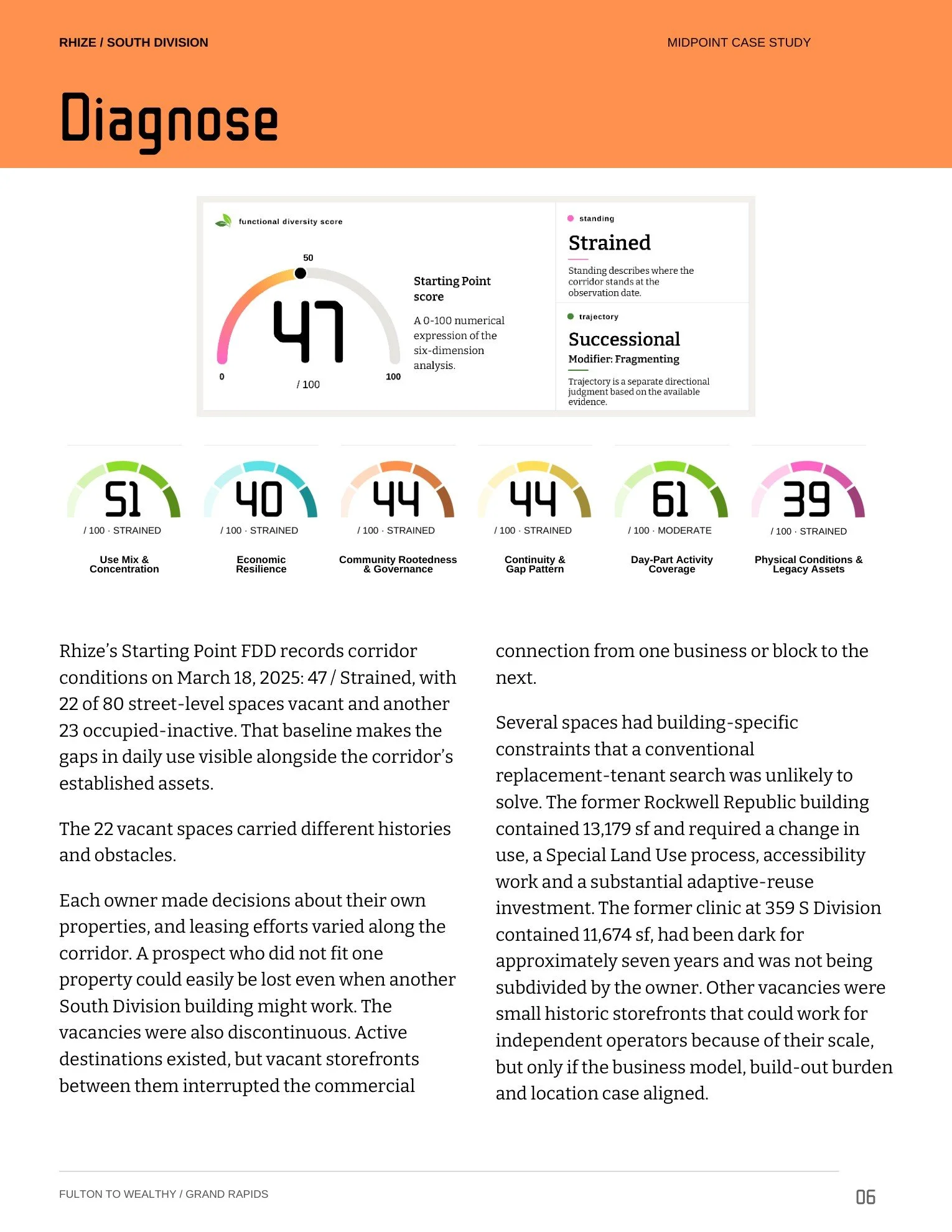
RHIZE / SOUTH DIVISION MIDPOINT CASE STUDY Diagnose Rhize’s Starting Point FDD records corridor conditions on March 18, 2025: 47 / Strained, with 22 of 80 street-level spaces vacant and another 23 occupied-inactive. That baseline makes the gaps in daily use visible alongside the corridor’s established assets. The 22 vacant spaces carried different histories and obstacles. Each owner made decisions about their own properties, and leasing efforts varied along the corridor. A prospect who did not fit one property could easily be lost even when another South Division building might work. The vacancies were also discontinuous. Active destinations existed, but vacant storefronts between them interrupted the commercial connection from one business or block to the next. Several spaces had building-specific constraints that a conventional replacement-tenant search was unlikely to solve. The former Rockwell Republic building contained 13,179 sf and required a change in use, a Special Land Use process, accessibility work and a substantial adaptive-reuse investment. The former clinic at 359 S Division contained 11,674 sf, had been dark for approximately seven years and was not being subdivided by the owner. Other vacancies were small historic storefronts that could work for independent operators because of their scale, but only if the business model, build-out burden and location case aligned. FULTON TO WEALTHY / GRAND RAPIDS Use Mix & Concentration Economic Resilience Community Rootedness & Governance Continuity & Gap Pattern DayPart Activity Coverage Physical Conditions & Legacy Assets / 100 · STRAINED 06
Read this page as text
RHIZE / SOUTH DIVISION
MIDPOINT CASE STUDY
Strategy
FULTON TO WEALTHY / GRAND RAPIDS
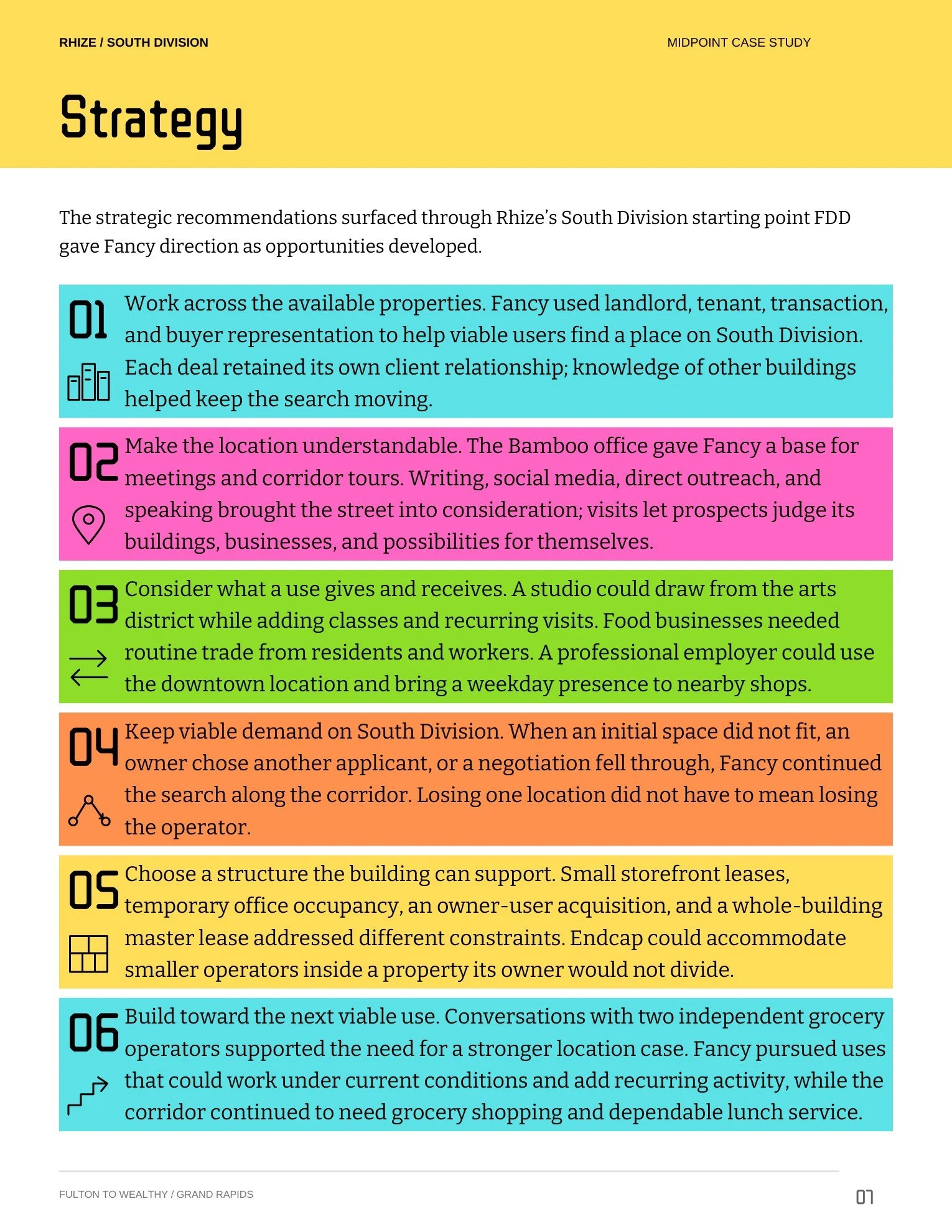
The strategic recommendations surfaced through Rhize’s South Division starting point FDD
gave Fancy direction as opportunities developed.
01
Work across the available properties. Fancy used landlord, tenant, transaction,
and buyer representation to help viable users find a place on South Division.
Each deal retained its own client relationship; knowledge of other buildings
helped keep the search moving.
02
Make the location understandable. The Bamboo office gave Fancy a base for
meetings and corridor tours. Writing, social media, direct outreach, and
speaking brought the street into consideration; visits let prospects judge its
buildings, businesses, and possibilities for themselves.
03
Consider what a use gives and receives. A studio could draw from the arts
district while adding classes and recurring visits. Food businesses needed
routine trade from residents and workers. A professional employer could use
the downtown location and bring a weekday presence to nearby shops.
04
Keep viable demand on South Division. When an initial space did not fit, an
owner chose another applicant, or a negotiation fell through, Fancy continued
the search along the corridor. Losing one location did not have to mean losing
the operator.
05
Choose a structure the building can support. Small storefront leases,
temporary office occupancy, an owner-user acquisition, and a whole-building
master lease addressed different constraints. Endcap could accommodate
smaller operators inside a property its owner would not divide.
06
Build toward the next viable use. Conversations with two independent grocery
operators supported the need for a stronger location case. Fancy pursued uses
that could work under current conditions and add recurring activity, while the
corridor continued to need grocery shopping and dependable lunch service.
07
Read this page as text
RHIZE / SOUTH DIVISION
MIDPOINT CASE STUDY
Implement
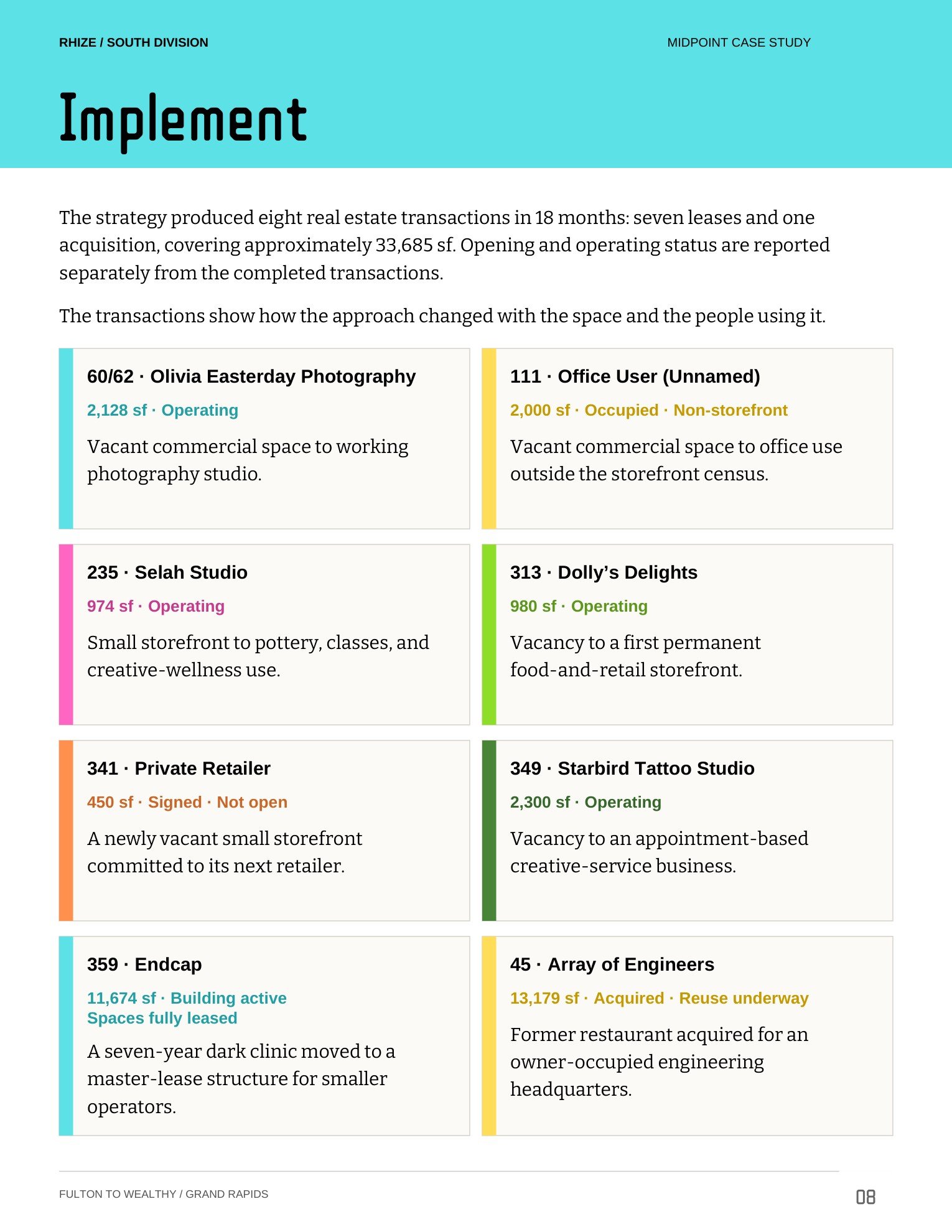
The strategy produced eight real estate transactions in 18 months: seven leases and one
acquisition, covering approximately 33,685 sf. Opening and operating status are reported
separately from the completed transactions.
The transactions show how the approach changed with the space and the people using it.
FULTON TO WEALTHY / GRAND RAPIDS
60/62 · Olivia Easterday Photography
2,128 sf · Operating
Vacant commercial space to working
photography studio.
111 · Office User (Unnamed)
2,000 sf · Occupied · Non-storefront
Vacant commercial space to office use
outside the storefront census.
235 · Selah Studio
974 sf · Operating
Small storefront to pottery, classes, and
creative-wellness use.
313 · Dolly’s Delights
980 sf · Operating
Vacancy to a first permanent
food-and-retail storefront.
341 · Private Retailer
450 sf · Signed · Not open
A newly vacant small storefront
committed to its next retailer.
349 · Starbird Tattoo Studio
2,300 sf · Operating
Vacancy to an appointment-based
creative-service business.
359 · Endcap
11,674 sf · Building active
Spaces fully leased
A seven-year dark clinic moved to a
master-lease structure for smaller
operators.
45 · Array of Engineers
13,179 sf · Acquired · Reuse underway
Former restaurant acquired for an
owner-occupied engineering
headquarters.
08
Read this page as text
RHIZE / SOUTH DIVISION
MIDPOINT CASE STUDY
Steward
FULTON TO WEALTHY / GRAND RAPIDS
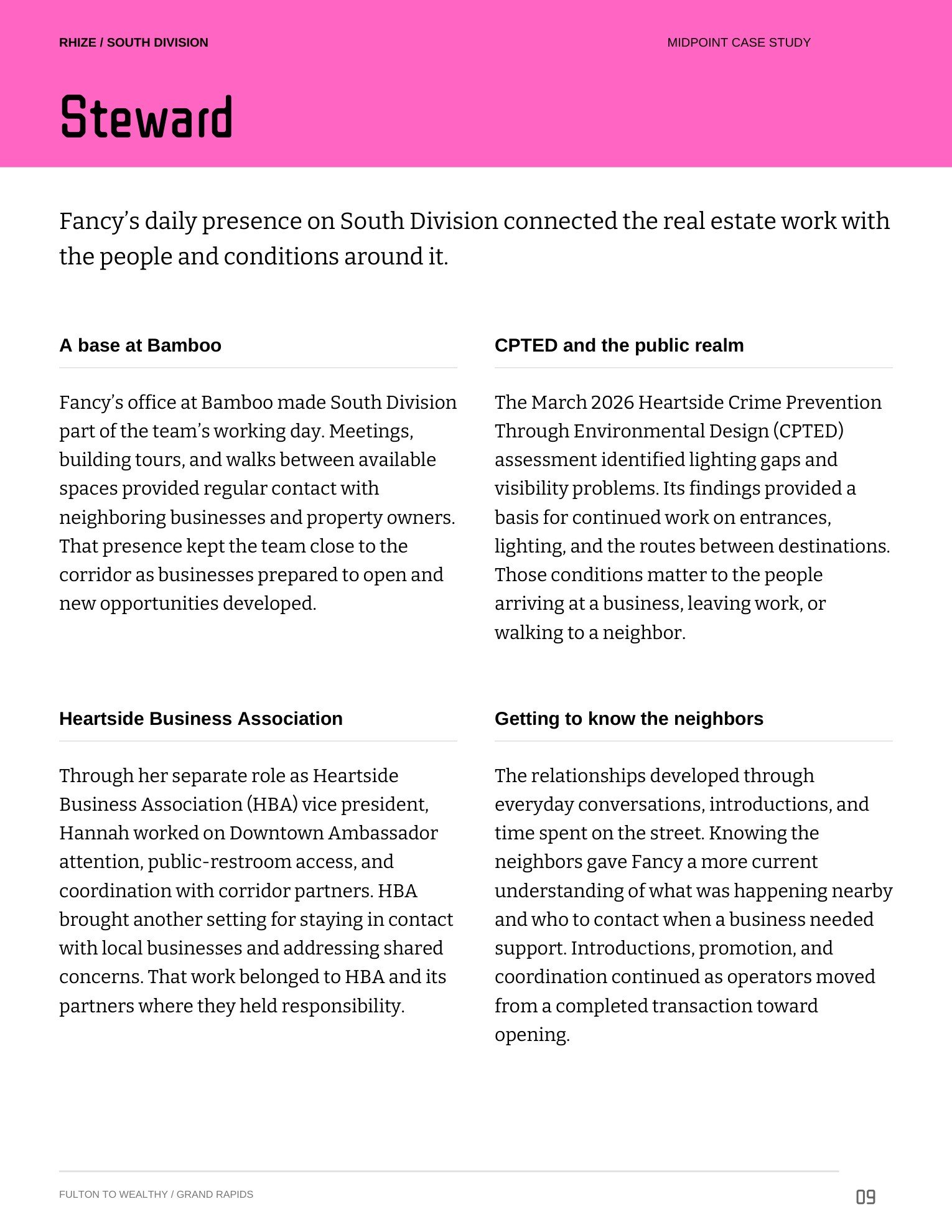
Fancy’s daily presence on South Division connected the real estate work with
the people and conditions around it.
A base at Bamboo
Fancy’s office at Bamboo made South Division
part of the team’s working day. Meetings,
building tours, and walks between available
spaces provided regular contact with
neighboring businesses and property owners.
That presence kept the team close to the
corridor as businesses prepared to open and
new opportunities developed.
CPTED and the public realm
The March 2026 Heartside Crime Prevention
Through Environmental Design (CPTED)
assessment identified lighting gaps and
visibility problems. Its findings provided a
basis for continued work on entrances,
lighting, and the routes between destinations.
Those conditions matter to the people
arriving at a business, leaving work, or
walking to a neighbor.
Heartside Business Association
Through her separate role as Heartside
Business Association (HBA) vice president,
Hannah worked on Downtown Ambassador
attention, public-restroom access, and
coordination with corridor partners. HBA
brought another setting for staying in contact
with local businesses and addressing shared
concerns. That work belonged to HBA and its
partners where they held responsibility.
Getting to know the neighbors
The relationships developed through
everyday conversations, introductions, and
time spent on the street. Knowing the
neighbors gave Fancy a more current
understanding of what was happening nearby
and who to contact when a business needed
support. Introductions, promotion, and
coordination continued as operators moved
from a completed transaction toward
opening.
09
Read this page as text
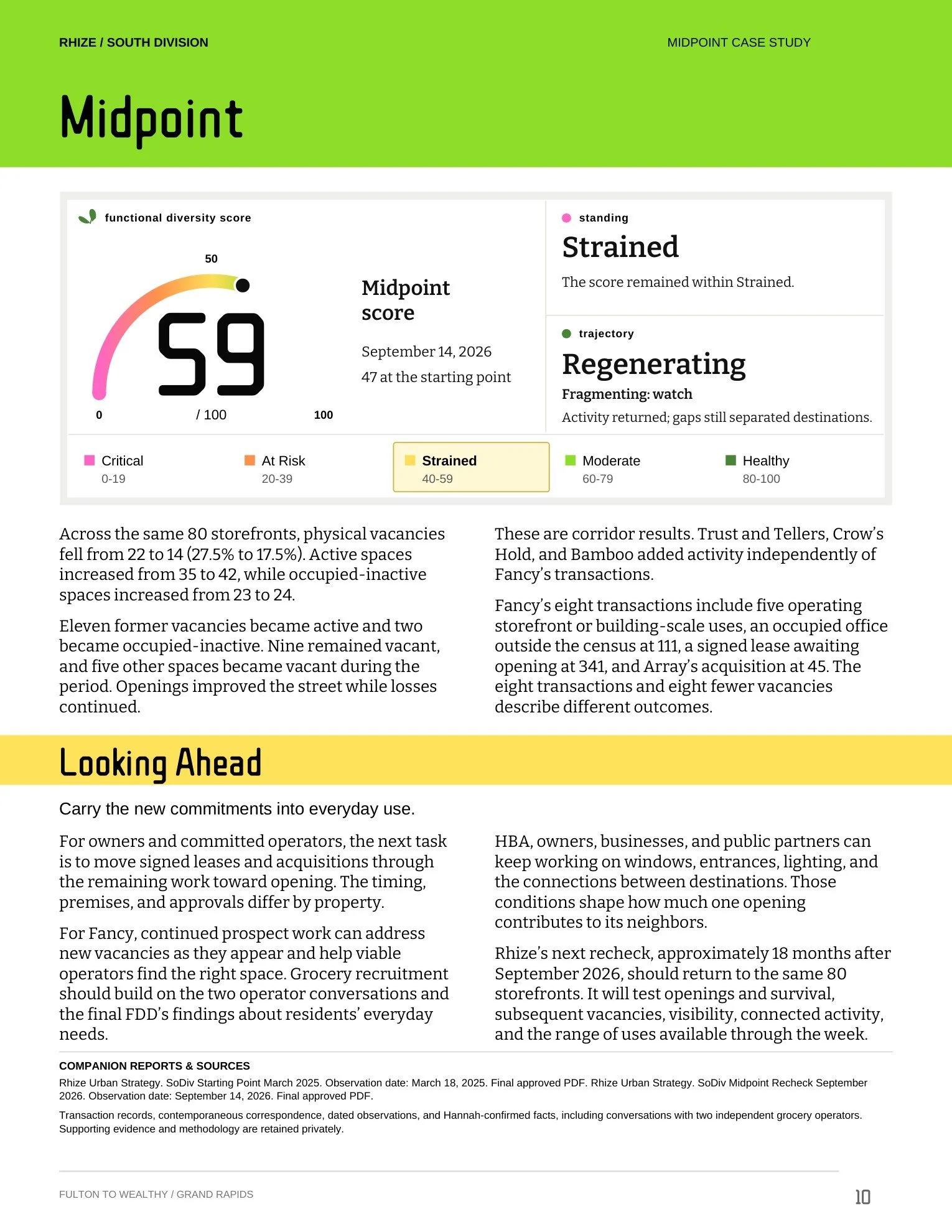
RHIZE / SOUTH DIVISION MIDPOINT CASE STUDY Midpoint FULTON TO WEALTHY / GRAND RAPIDS 10 functional diversity score 59 0 50 100 / 100 Midpoint score September 14, 2026 47 at the starting point standing trajectory Strained The score remained within Strained. Regenerating Fragmenting: watch Activity returned; gaps still separated destinations. Critical 0-19 At Risk 20-39 Strained 40-59 Moderate 60-79 Healthy 80-100 Across the same 80 storefronts, physical vacancies fell from 22 to 14 (27.5% to 17.5%). Active spaces increased from 35 to 42, while occupied-inactive spaces increased from 23 to 24. Eleven former vacancies became active and two became occupied-inactive. Nine remained vacant, and five other spaces became vacant during the period. Openings improved the street while losses continued. These are corridor results. Trust and Tellers, Crow’s Hold, and Bamboo added activity independently of Fancy’s transactions. Fancy’s eight transactions include five operating storefront or building-scale uses, an occupied office outside the census at 111, a signed lease awaiting opening at 341, and Array’s acquisition at 45. The eight transactions and eight fewer vacancies describe different outcomes. Looking Ahead Carry the new commitments into everyday use. For owners and committed operators, the next task is to move signed leases and acquisitions through the remaining work toward opening. The timing, premises, and approvals differ by property. For Fancy, continued prospect work can address new vacancies as they appear and help viable operators find the right space. Grocery recruitment should build on the two operator conversations and the final FDD’s findings about residents’ everyday needs. HBA, owners, businesses, and public partners can keep working on windows, entrances, lighting, and the connections between destinations. Those conditions shape how much one opening contributes to its neighbors. Rhize’s next recheck, approximately 18 months after September 2026, should return to the same 80 storefronts. It will test openings and survival, subsequent vacancies, visibility, connected activity, and the range of uses available through the week. COMPANION REPORTS & SOURCES Rhize Urban Strategy. SoDiv Starting Point March 2025. Observation date: March 18, 2025. Final approved PDF. Rhize Urban Strategy. SoDiv Midpoint Recheck September 2026. Observation date: September 14, 2026. Final approved PDF. Transaction records, contemporaneous correspondence, dated observations, and Hannahconfirmed facts, including conversations with two independent grocery operators. Supporting evidence and methodology are retained privately.
Keep a copy
Enter your name and email below for immediate access to the PDF. Rhize records these details to understand who is using the case study. This does not subscribe you to a mailing list.